일연 一然
Late Goryeo monk and author of the Samguk Yusa; National Preceptor
| Life | 1206 ~ 1289 |
| Era | 고려 후기 |
| Clan | 김씨(일설 전씨) |
Life & career
Il-yeon (一然, 1206-1289) was a Buddhist monk of the late Goryeo period and the author of the Samguk Yusa (Memorabilia of the Three Kingdoms). He was first named Gyeon-myeong, with the courtesy name Hoe-yeon, before taking the name Il-yeon; his pen name was Mogam, and his posthumous title Bogak. He is said to have been born in Jangsan-gun, around present-day Gyeongsan, North Gyeongsang Province.
He entered monastic life around 1219, passed the monks' examination in 1227, and rose to Seonsa in 1246 and Daeseonsa in 1259. During the Mongol invasions he moved among temples such as Bodang Hermitage, Jeongnimsa on Namhae and Oeosa in Pohang, and in the early 1280s he was raised to the title of National Preceptor (Gukjon).
In his later years he stayed at Ingaksa in Gunwi to care for his aged mother, and the Samguk Yusa is believed to have been completed there. He died at Ingaksa in 1289. His lay surname is Kim according to his stele inscription, but a recent view argues it was Jeon; this page therefore records both views rather than asserting a clan seat.
Birth and entry into monastic life
His stele inscription records that his father Eon-pil held no office and that his mother was of the Yi family. He was born in the sixth month of 1206 in Jangsan-gun in the Gyeongju region (around present-day Gyeongsan), and was named Gyeon-myeong, with the courtesy name Hoe-yeon.
At nine (around 1214) he studied at Muryangsa, and in 1219 he is said to have been tonsured under the elder Daeung at Jinjeonsa on Mt. Seorak and received the full precepts. Jinjeonsa is associated with the origin of the Gaji school among the Nine Mountains of Seon, so Il-yeon is classed within the Seon tradition.
On his lay surname. The inscription and older accounts give Kim, but a study around 2017 argued for Jeon (Jeon Gyeon-myeong), and sources such as Wikipedia list both. The common label 'Gyeongju Kim' is likewise not confirmed by the sources, so no clan seat is asserted here.
Career as a monk
Il-yeon passed the monks' examination in 1227, became Seonsa in 1246 and Daeseonsa in 1259. This was the era of the long war with the Mongols, and his stele inscription records stays at Bodang Hermitage on Mt. Po, Mumu Nanya, Jeongnimsa on Namhae and, in 1264, a sojourn at Oeosa (in present-day Pohang).
In 1261 he was summoned by King Wonjong to serve as abbot of Seonwolsa in Gaegyeong; he later restored Inhungsa. In 1268 he presided over the completion ceremony of the Tripitaka at Unhaesa, and in 1277 he became abbot of Unmunsa.
King Chungnyeol sought to honor him as National Preceptor (Gukjon). The year differs by source, roughly 1281-1282 by inference from the stele or 1283. Citing his aged mother, he returned to the region near his hometown and stayed at Ingaksa, which one account says he rebuilt on land granted by the court.
Compilation of the Samguk Yusa
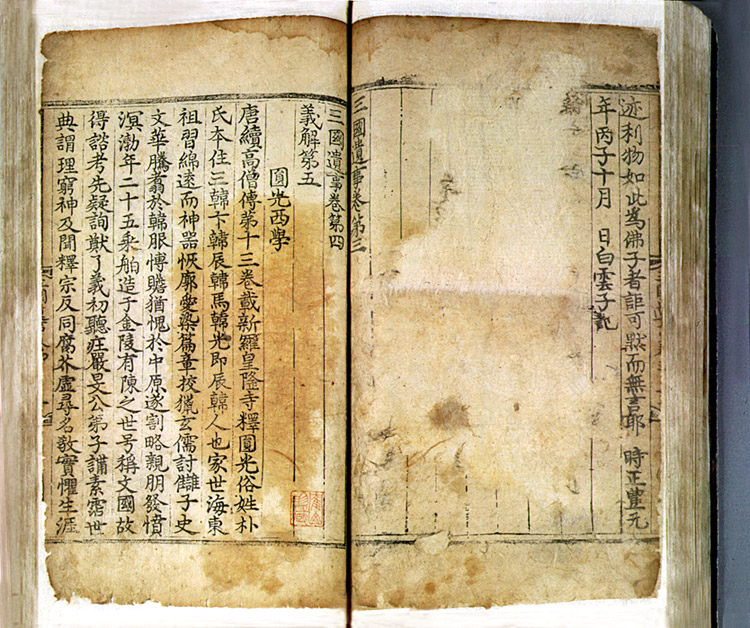
The Samguk Yusa is believed to have been completed around 1281, while Il-yeon was staying at Ingaksa in Gunwi. No Goryeo-period printing survives; what remains are early Joseon editions and the 1512 Jeongdeok-era reprint made in Gyeongju.
The work has five fascicles in nine sections: Wangnyeok (chronology), Gii (marvels), Heungbeop (the rise of Buddhism), Tapsang (pagodas and images), Uihae (eminent monks' exegesis), Sinju (spells), Gamtong (spiritual responses), Pieun (hermits) and Hyoseon (filial piety and virtue). Gii collects founding myths and royal tales from Gojoseon onward, while the Buddhist sections cover the origins of temples, pagodas and images, monks, and tales of the marvelous.
A widely accepted view holds that his disciple Mugeuk (Hon-gu) supplemented and published the book, since the phrase 'Mugeuk's note' remains in the text. Scholars disagree on the date and extent of his role, with proposals ranging from printing in the 1310s to a final form around 1360, and some even suggest a third person; there is no settled view.
Tales in the Samguk Yusa
The Samguk Yusa preserves many stories that the official histories barely mention. The account of Dangun founding Gojoseon appears in its Gii section and is a key source for the Dangun myth. It also preserves 14 Silla hyangga songs, which are central to the study of early Korean literature.
Well-known tales said to be recorded there include that of Yeono-rang and Seo-nyeo, whose departure for Japan supposedly dimmed the sun and moon; the Seodong song tale of Seodong and Princess Seonhwa; Cheoyong, who is said to have answered a plague spirit with song and dance; and the Manpasikjeok flute made from bamboo sent by a dragon. These should be read as collected traditions, not literal history.
Comparison with the Samguk Sagi
The Samguk Sagi, compiled by Kim Bu-sik on royal order in 1145, is an official history in the annals-and-biographies format. The Samguk Yusa, by contrast, is a monk's personal work that readily includes myth, Buddhist tales and hyangga. Its periodization also differs, dividing the past into early, middle and late ages.
The two books complement each other: material on Gojoseon, Gaya and Buddhism absent from the Samguk Sagi can be found in the Samguk Yusa. Figures such as Kim Yu-sin, Choe Chi-won and Seol Chong appear in both works.
Sites and later assessment
After his death a stupa was raised on the ridge east of Ingaksa, and the Stele of National Preceptor Bogak is said to have been erected in 1295. Min Ji wrote the front text and Sanrim the reverse, while his disciple Jukheo assembled calligraphy of Wang Xizhi for the carving; one account says it was based on a biography submitted by the disciple Cheongbun. The stele is heavily damaged and only part survives; the stupa is designated Treasure No. 428.
Several editions of the Samguk Yusa are now designated National Treasures (the 1512 Jungjong edition is No. 306-2), and it was reportedly inscribed on the UNESCO Memory of the World Asia-Pacific register in 2022. Il-yeon is remembered as a monk who recorded folk traditions and ancient culture broadly.
Among his contemporaries was the general Kim Bang-gyeong, active during the Mongol wars. A claim that a historical summary by Yi Je-hyeon is cited in the Samguk Yusa has been proposed, but it is not settled.
Related National Treasures
National Treasures and Treasures connected to this figure (Korean-language pages).
Related temples
Buddhist temples connected to this figure (Korean-language pages).
Grave
A stupa stands on the ridge east of Ingaksa in Gunwi, with the Stele of National Preceptor Bogak; the stupa is Treasure No. 428.
Descendants
As a monk he left no descendants; disciples recorded include Cheongbun, Jukheo and Mugeuk (Hon-gu).