정발 鄭撥
Commander of Busanjin who died a martyr at the Battle of Busanjin in the Imjin War; posthumous title Chungjang; the Black-Clothed General
| Life | 1553 ~ 1592 |
| Era | 조선 |
| Clan | 경주 정씨 |
Life & career
Jeong Bal (1553-1592), courtesy name Jago and pen name Baegun, belonged to the Gyeongju Jeong clan. He was a sixth-generation descendant of the Joseon founding merit subject Jeong Hui-gye; Hui-gye's son Jeong Gil-sang is recorded as Jeong Bal's ancestor five generations up. He passed the military examination in 1579, held posts such as magistrate of Haenam, magistrate of Geoje, aide to a northern field marshal, and Hunryeonwon deputy commander, and in 1592 was promoted to Jeoljung general and appointed naval commander (cheomjeoljesa) of Busanjin.
When the Imjin War broke out in April 1592, Konishi Yukinaga's army struck Busanjin first. With only about a thousand men Jeong Bal held the fortress, fighting in black armor that earned him the name "Black-Clothed General", and fell to a bullet during close combat at the age of 39. He is said to have refused demands to surrender or open the way and to have told his men urging escape that he would become a ghost of the fortress.
His body could not be found and the funeral was held with his clothes and cap; a rumor that he had defected was dispelled by eyewitness accounts of his death. He was posthumously raised to Minister of War and then Left Minister (Jwachanseong), and in 1686 received the title Chungjang.
The Battle of Busanjin and the Black-Clothed General
A story says that when the Japanese vanguard appeared off Busan in April 1592 Jeong Bal was hunting on Jeolyeongdo and hurried back to defend the fortress; this is best read as later tradition. What is clear is that Busanjin was the first battlefield of the Imjin War and that Jeong Bal died without abandoning the fortress. Together with Song Sang-hyeon, who died at Dongnae, he is remembered as a symbol of the early resistance.
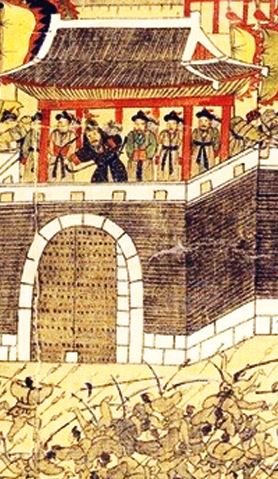
The battle is preserved in the Busanjin Sunjeoldo painted by Byeon Bak in 1760, which shows Joseon troops facing the Japanese forces encircling the fortress and tells how later generations remembered the fight.
Memorials and Sites
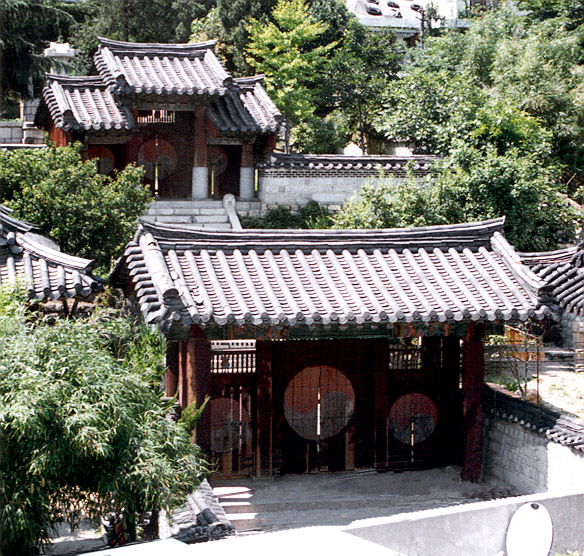
An altar, Jeonggongdan, was built in 1766 at the site of the south gate of Busanjin fortress where he fell; it is preserved as a Busan monument and rites continue. He is enshrined at Allak Seowon in Dongnae, and a statue of him stands in Choryang-dong, Busan. His tomb at Baekseok-ri, Misan-myeon, Yeoncheon is a Gyeonggi Province monument.
Descendants and the clan are said to be linked with the clan village around Baekseok-ri, Yeoncheon. Rite schedules change from year to year, so check with Dong-gu Office in Busan or the clan.
Lineage and Namesakes
Jeong Bal is traced as a sixth-generation descendant of Jeong Hui-gye of the Yanggyeong-gong branch; Hui-gye's son Jeong Gil-sang is his ancestor five generations up. He is introduced in the same Yanggyeong-gong line as Jeong Hyo-sang, but the exact degree of kinship between them could not be confirmed.
Another Jeong Bal (鄭發, b. 1389) was an early Joseon civil official, a different person. Jeong Ji (鄭地) of the Naju Jeong clan was a late Goryeo naval commander, a different seat and era from Gyeongju Jeong Bal.
Grave
He is buried together with his wife of the Pungcheon Im clan at Baekseok-ri, Misan-myeon, Yeoncheon, Gyeonggi Province; the tomb has been a Gyeonggi Province monument (No. 51) since 1979. In Busan the altar Jeonggongdan (Busan Monument No. 10) stands near the old Busanjin fortress site.
Descendants
His son was Jeong Heun; a fourth-generation descendant, Jeong In-jung, was executed in 1722 during the Imin purge. He is counted with his ancestor Jeong Hui-gye and Jeong Hyo-sang among the leading figures of the Yanggyeong-gong branch. Jeong Bal (鄭發, b. 1389), an early Joseon civil official, is a different person.
Related photos