이순신 李舜臣
Mid-Joseon military commander; renowned admiral of the Imjin War; first Commander of the Three Naval Provinces; posthumous title Chungmugong (忠武公)
| Life | 1545 ~ 1598 |
| Era | 조선 |
| Clan | 덕수 이씨 |
Life & career
Yi Sun-sin (李舜臣, 1545-1598) was a mid-Joseon military commander of the Deoksu Yi clan, courtesy name Yeohae (汝諧), posthumous title Chungmu (忠武). Born in 1545 in Geoncheon-dong, Hanseong, he passed the military examination in 1576 and, after posts on the Hamgyeong frontier, as naval commander at Balpo and as Magistrate of Jeongeup, was appointed Left Jeolla Naval Commander in 1591.
When the Imjin War broke out he won successive victories at Okpo, Sacheon, Hansando, Busanpo and elsewhere, gaining command of the southern seas, and in 1593 became the first Commander of the Three Naval Provinces. In 1597 he was dismissed and imprisoned on slander and served in white clothes; after the defeat at Chilcheonryang he was restored and won a great victory at Myeongnyang with thirteen ships.
On November 19, 1598 (lunar) he was killed at the Battle of Noryang while pursuing the retreating Japanese. His War Diary (National Treasure No. 76) is a core source for Imjin War studies, and Hyeonchungsa in Asan, Chungnyeolsa in Tongyeong and Jeseungdang on Hansando commemorate him.
Birth and Family Background
Yi Sun-sin (李舜臣) was born on the 8th day of the 3rd lunar month of 1545 (April 28 in the solar calendar), in Geoncheon-dong, Hanseong (present-day Injeon-dong area, Jung-gu, Seoul). He belonged to the Deoksu Yi clan, and his courtesy name was Yeohae (汝諧). His father was Yi Jeong (李貞) and his mother was Lady Byeon of the Chogye Byeon clan; the family was of the scholar-official class, but by his father's generation it is said not to have been prosperous.
He had two elder brothers, Yi Hui-sin (李羲臣) and Yi Yo-sin (李堯臣), and a younger brother, Yi U-sin (李禹臣). It is widely explained that the four brothers' names were taken from the legendary Chinese rulers Fuxi, Yao, Shun and Yu; Sun-sin's name is read as 'a minister of Shun'. When his elder brothers died young, he is said to have raised his nephews as if they were his own sons.
He is said to have spent his childhood in Geoncheon-dong as a neighbor of Ryu Seong-ryong (柳成龍), later Chief State Councillor, who wrote in his Jingbirok that Yi was talented from a young age and a fine archer. The family later moved to the Asan area of Chungcheong Province, which became his lifelong home; sources vary on the timing and circumstances. His later rival Won Gyun (元均) was a contemporary, and a childhood acquaintance is often mentioned, but no document confirms any specific early contact between them.
Turning to Martial Arts and the Military Examination
Yi married the daughter of the military official Bang Jin (方震) in 1565 (age 21), and is said to have begun serious martial training around the age of 22. His wife's family was in Asan, and the couple's household was based there. That he first studied the civil curriculum and turned to the military examination relatively late is regarded as a distinctive feature of his career.
In 1572 (age 28), during a special military examination at the Hunryeonwon (Military Training Agency) in Hanseong, he fell from his horse and was injured, failing the test. A story is told that he bound his broken leg with willow bark and finished the test, but this rests on later accounts.
Four years later, in 1576 (the 9th year of King Seonjo), he passed the regular military examination in the byeong grade, ranked fourth (age 32). Chronologies differ on whether this fell in the 2nd, 3rd or 4th lunar month. His first post was acting Bongsa of the Hunryeonwon, and in the 12th month of the same year he was sent as Gwongwan to Donggubibo, a fort on the far northern frontier of Hamgyeong Province, beginning years of frontier service.
Frontier Posts and the Balpo Naval Command
After about three years at Donggubibo, Yi returned to Hanseong in 1579 to serve at the Hunryeonwon, and soon became an aide to the Military Commander of Chungcheong, based at Haemi. It is told that when the Ministry of War official Seo Ik (徐益) pressed him for a personnel favor, Yi refused, earning Seo's grudge, and later suffered in a military inspection.
In the 7th lunar month of 1580 he became Naval Commander (Suneun Manho) at Balpo in Jeolla Province (present-day Goheung, South Jeolla), his first naval post. Well-known stories from this time include his refusal to let a superior fell a paulownia tree in the Balpo office compound to make a geomungo zither, on the grounds that it was public property, and a downgrade given in a military inspection at Seo Ik's behest. These episodes are linked to his dismissal in 1582, but the exact sequence differs between sources and cannot be stated with certainty.
After leaving the Balpo post in 1582 he was reinstated as a Hunryeonwon Bongsa. His upright character and refusal to bend principles repeatedly caused him trouble in office, yet sources agree that these same traits became the core of how he was later judged.
Hamgyeong Province - Geonwonbo, Nokdundo and the First 'Service in White'
Around the 7th lunar month of 1583 he became an aide to Yi Yong (李鏞), Military Commander of Southern Hamgyeong, and in the 8th month was sent as Gwongwan of Geonwonbo (乾原堡) during the Jurchen revolt led by Nitanggae. He is said to have lured and captured the Jurchen chieftain Uljinae by a stratagem, though it is also told that his superior did not properly recognize the achievement. In the 11th month he was moved to a Hunryeonwon post; after his father Yi Jeong died and the three-year mourning period ended, he returned in 1586 as Jubu of the Royal Stables.
In 1586 he became Manho of Josanbo and farm-colony officer on Nokdundo, an island at the mouth of the Duman River, short of manpower. He is reported to have asked the Northern Commander Yi Il (李鎰) for more troops without success. When Jurchen raiders attacked in the 9th lunar month of 1587, Yi and Yi Gyeong-rok (李慶祿) fought back, drove off part of the raiders and recovered captives. Casualty figures vary greatly between sources (a dozen or so Joseon dead, a hundred or more captives, and so on).
Yi Il, however, blamed him for the defeat and sought to try him under military law; by King Seonjo's order Yi Sun-sin was flogged and sentenced to serve as a common soldier without rank, 'in white clothes' (baekui jonggun) on the 16th day of the 10th lunar month of 1587 (Seonjo Sillok). This was the first of his two such sentences. In 1588 he distinguished himself in the attack on the Sijeon Jurchen village and was pardoned, and around the 6th month returned home to Asan.
Magistrate of Jeongeup and Appointment as Left Jeolla Naval Commander
In 1589 he was chosen as Assistant Defense Commander (Jobangjang) under Jeolla Governor Yi Gwang (李洸), appeared on the Border Defense Council's list of recommended talents, served as a royal herald (Seonjeongwan), and in the 12th lunar month was appointed Magistrate of Jeongeup. Ryu Seong-ryong is said to have supported his recommendation for the Jeongeup post, and records connect several ministers, among them Jeong Eon-sin and Yi San-hae, with recommending him.
In 1590 he was recommended for the posts of Gosariajin and Manpojin garrison commander, but the Office of the Inspector-General objected that the promotion skipped ranks, and the plans fell through. In the 2nd lunar month of 1591, after postings as Magistrate of Jindo and Commander of Garipo, he was appointed Left Jeolla Naval Commander (Jeolla Jwasusa), a senior 3rd-rank post. The Inspector-General repeatedly objected to this exceptional promotion, but King Seonjo did not yield.
Explanations for the appointment usually cite the court's efforts to strengthen the navy in view of a possible Japanese invasion and Ryu Seong-ryong's recommendation, though whether Seonjo singled out Yi because he was already convinced war was coming is disputed. Dates also differ: sources give both a February 13 appointment and a March 8 arrival. The Left Jeolla Naval Command was at Yeosu, and covered the five counties of Suncheon, Nakan, Boseong, Gwangyang and Heungyang and the five ports of Sado, Bangdap, Yeodo, Nokdo and Balpo.
Preparing for War - Turtle Ships and Naval Training
After taking up his post, Yi repaired warships, trained crews in gunnery, inspected coastal fortifications and checked ordnance, as recorded in the 1592 entries of his War Diary. He ran military farm colonies (dunjeon) to secure provisions, and is said to have built a self-supporting base through fishing and salt production.
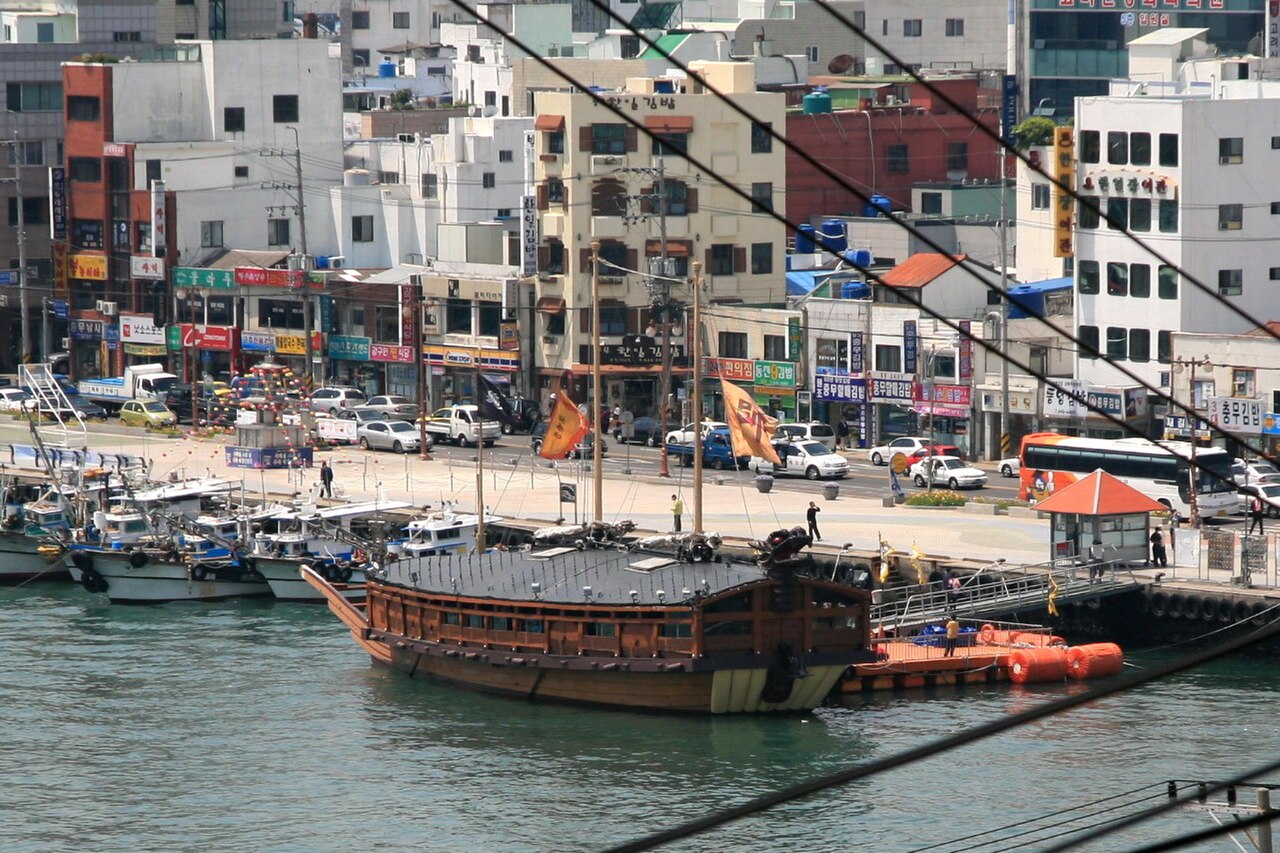
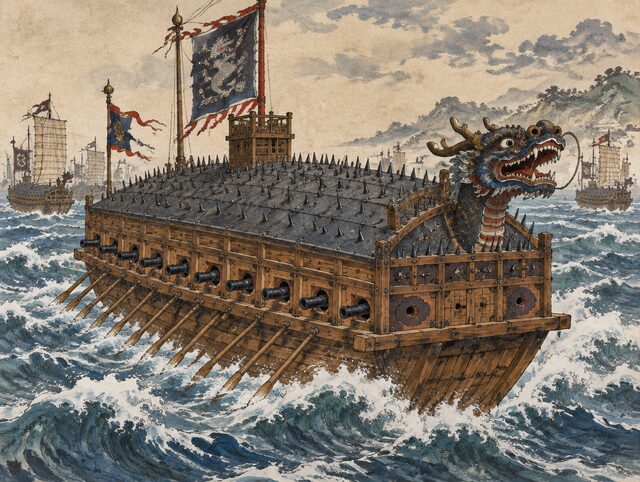
The turtle ship (geobukseon), completed in this period, was an assault vessel built on a panokseon hull with a roof over the deck, a dragon head at the bow and gun ports and spikes on all sides. The War Diary notes the receipt of 29 bolts of sail cloth for turtle ships on the 8th day of the 2nd lunar month of 1592, test firing of cannons from a turtle ship on March 27, and on April 12 sails being fitted to the finished vessel and cannons being tested. Because no blueprints survive, the exact structure (including whether the roof was armored with iron) remains debated among scholars.
The main warship of the Joseon navy was the panokseon, a vessel with an upper structure built over the deck that separated rowers from combat troops and made effective use of cannon. Yi exploited this advantage in ships and in guns such as the cheonja, jija, hyeonja and hwangja cannons, avoiding boarding combat and destroying enemy ships from a distance.
Outbreak of the Imjin War and the First Sortie - Okpo, Hapo and Jeokjinpo
The Imjin War began on the 13th day of the 4th lunar month of 1592 (May 24 in the solar calendar) with the Japanese landing at Busan. Yi is said to have received the news on the night of April 15 through a dispatch from Won Gyun, Right Gyeongsang Naval Commander. Because the area lay outside his jurisdiction and he lacked a court order, he weighed his response carefully for several days, and appeals from subordinate officers such as Jeong Un (鄭運) and Song Hui-rip (宋希立) are said to have weighed heavily in his decision to sortie.
At dawn on May 4 (lunar), he set out on his first sortie with a fleet of some 80 vessels, including about 20 panokseon, and joined the Gyeongsang naval forces off Geoje Island. On May 7 at Okpo he found about 30 Japanese ships and attacked; his dispatch reported 26 ships sunk. At Hapo he sank 5 more, and the next day at Jeokjinpo some ten ships (reported as 11 to 13). Joseon losses are recorded as only a few wounded.
This was the Joseon navy's first victory and welcome news for a court and populace that had suffered repeated defeats on land. The figures follow Joseon reports and differ from Japanese records. For this victory King Seonjo is said to have raised Yi to the rank of Gaseon Daebu.
Second Sortie - Sacheon, Dangpo, Danghangpo, Yulpo and the Turtle Ship's Debut
The second sortie began on May 27 (lunar) and fought the Japanese at Sacheon on May 29. In this battle the turtle ship saw its first combat, charging into the enemy line; the dispatch recorded 13 Japanese vessels destroyed. Yi is said to have been hit by a bullet in the left shoulder in the action but kept commanding without showing it.
At Dangpo on June 2 the fleet destroyed 21 ships including a large vessel carrying a Japanese commander, and on June 4 Yi Eok-gi's Right Jeolla fleet joined. On June 5 at Danghangpo 26 ships were destroyed, and on June 7 at Yulpo 3 ships destroyed and 4 captured; Joseon dead on this sortie are reported at around 11. All figures come from Joseon dispatches.
The string of victories raised Yi's rank to Jaheon Daebu, and the Joseon navy effectively gained control of the sea along the southern Gyeongsang coast, seriously disrupting the Japanese plan for combined land and sea advance.
The Battle of Hansando and the Battle of Busanpo
The Battle of Hansando took place off Hansan Island on the 8th day of the 7th lunar month of 1592 (August 14 in the solar calendar). Told that the Japanese fleet under Wakizaka Yasuharu (脇坂安治) was anchored in the Gyeonnaeryang strait, Yi judged the narrow, reef-strewn channel unfavorable and used a few panokseon to lure the enemy out into the open sea off Hansando. The Joseon fleet then surrounded the Japanese ships in the crane-wing formation (hagikjin) and poured gunfire into them.
The Joseon fleet, together with Yi Eok-gi and Won Gyun, is reported to have fielded more than 50 panokseon plus turtle ships against about 70 Japanese vessels. The dispatch records 47 enemy ships sunk and 12 captured, with 19 Korean dead. On the 10th Yi attacked the Japanese at Angolpo. Exact numbers vary between sources.
The battle badly disrupted the Japanese plan of linking the capital and Pyongyang through a combined land and sea advance by supply routes in the west, and Toyotomi Hideyoshi is said to have ordered a halt to naval operations. The American missionary and scholar Homer Hulbert is known to have called it Joseon's Battle of Salamis.
On the 1st day of the 9th lunar month the same year came the Battle of Busanpo. Yi advanced with Yi Eok-gi and Won Gyun into the waters near the main Japanese base at Busan and reported destroying more than 100 enemy ships, but the battle cost the life of Jeong Un, commander at Nokdo. Yi is said to have held a memorial rite for him.
Commander of the Three Naval Provinces and the Hansando Years (1593-1597)
From February to May 1593 (lunar) Yi engaged the Japanese repeatedly at Ungpo, but the Japanese stayed behind newly built walls and no major result was achieved. In July of that year he moved the Left Jeolla headquarters to Hansando, and in August was appointed Commander of the Three Naval Provinces (Samdo Sugun Tongjesa; records give August 1 or 15), placing the fleets of Gyeongsang, Jeolla and Chungcheong under a single command.
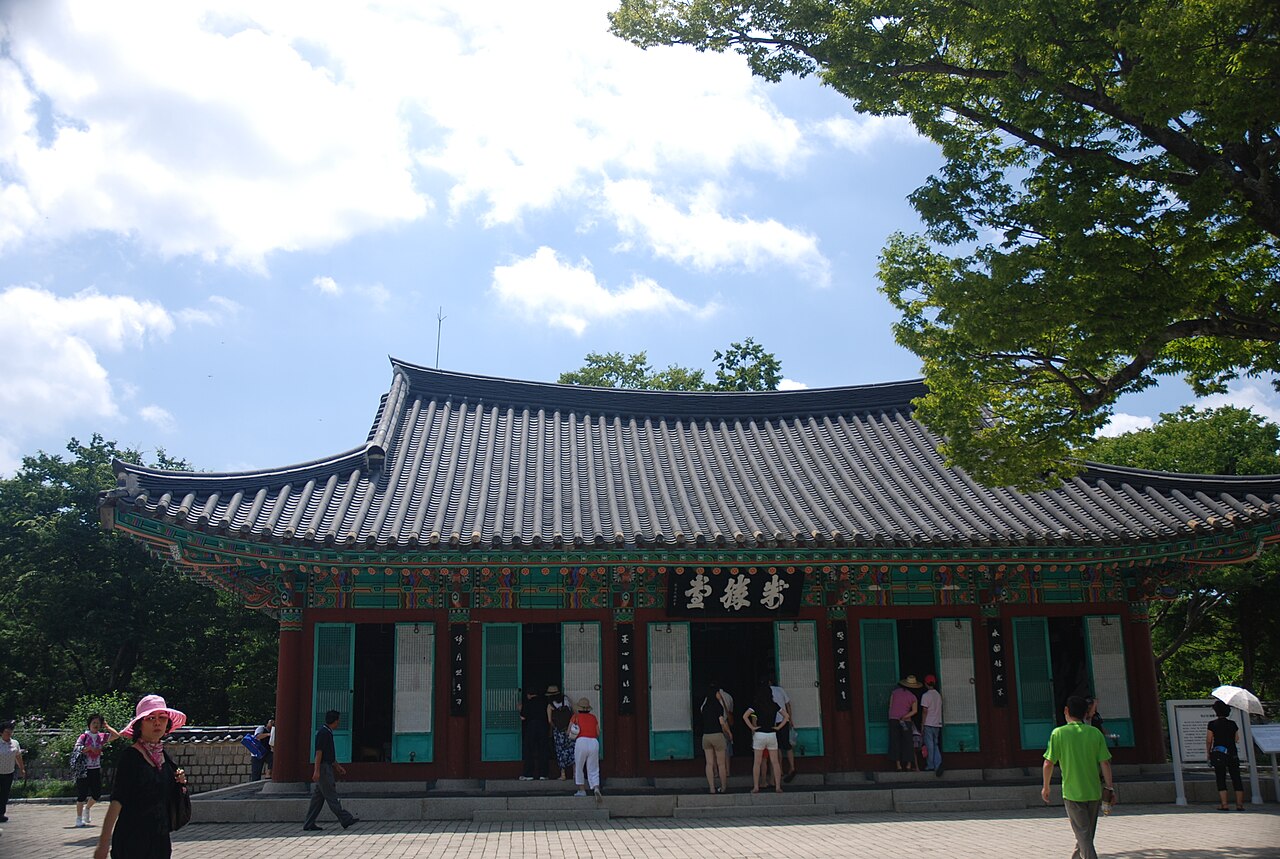
On Hansando he kept a command hall called Unjudang (運籌堂), where he is said to have discussed operations with his officers; this is the origin of today's Jeseungdang (制勝堂). He ran farm colonies, boiled salt and fished to secure provisions, and in 1594 is reported to have held a military examination at the camp. A dispatch survives reporting heavy losses to disease and hunger in the navy in the spring of that year.
During these years he brought his mother, Lady Byeon, to Gojeumcheon near the Yeosu headquarters to care for her, and the War Diary often records his inquiries after her, calling her 'Cheonji' (天只). Meanwhile his conflict with Won Gyun, Right Gyeongsang Naval Commander, deepened, and the diary contains many critical remarks about him. Around 1595 Won Gyun was transferred to be Chungcheong Army Commander.
The War Diary, Letters and Poems (National Treasure No. 76)
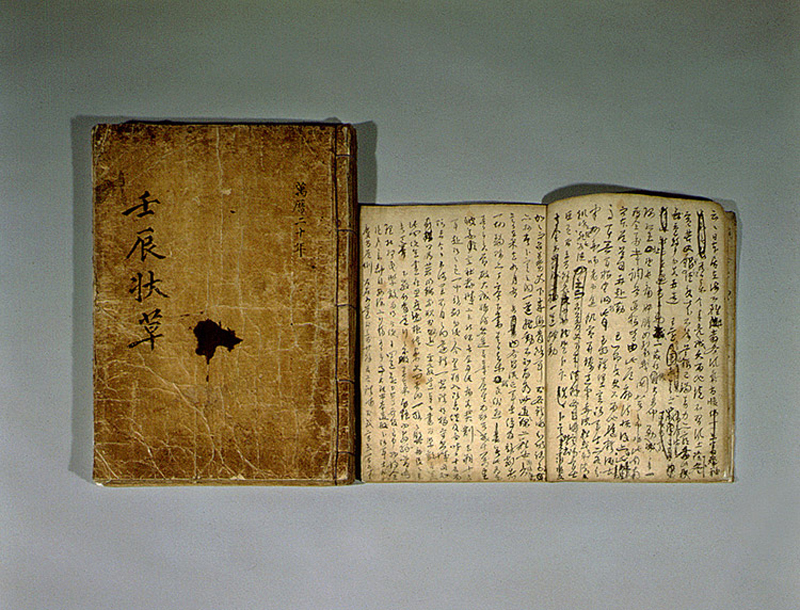
The War Diary (Nanjung Ilgi, 亂中日記) is the field diary Yi kept from the 1st day of the 1st lunar month of 1592 to November 17, 1598, two days before his death. Originally it consisted of draft volumes named for each year, such as the Imjin, Gyesa, Gabo, Byeongsin, Jeongyu and Musul diaries; when the Complete Works of Yi Chungmugong (Ichungmugong Jeonseo) were compiled in 1795 by order of King Jeongjo, they were combined and given the title Nanjung Ilgi.
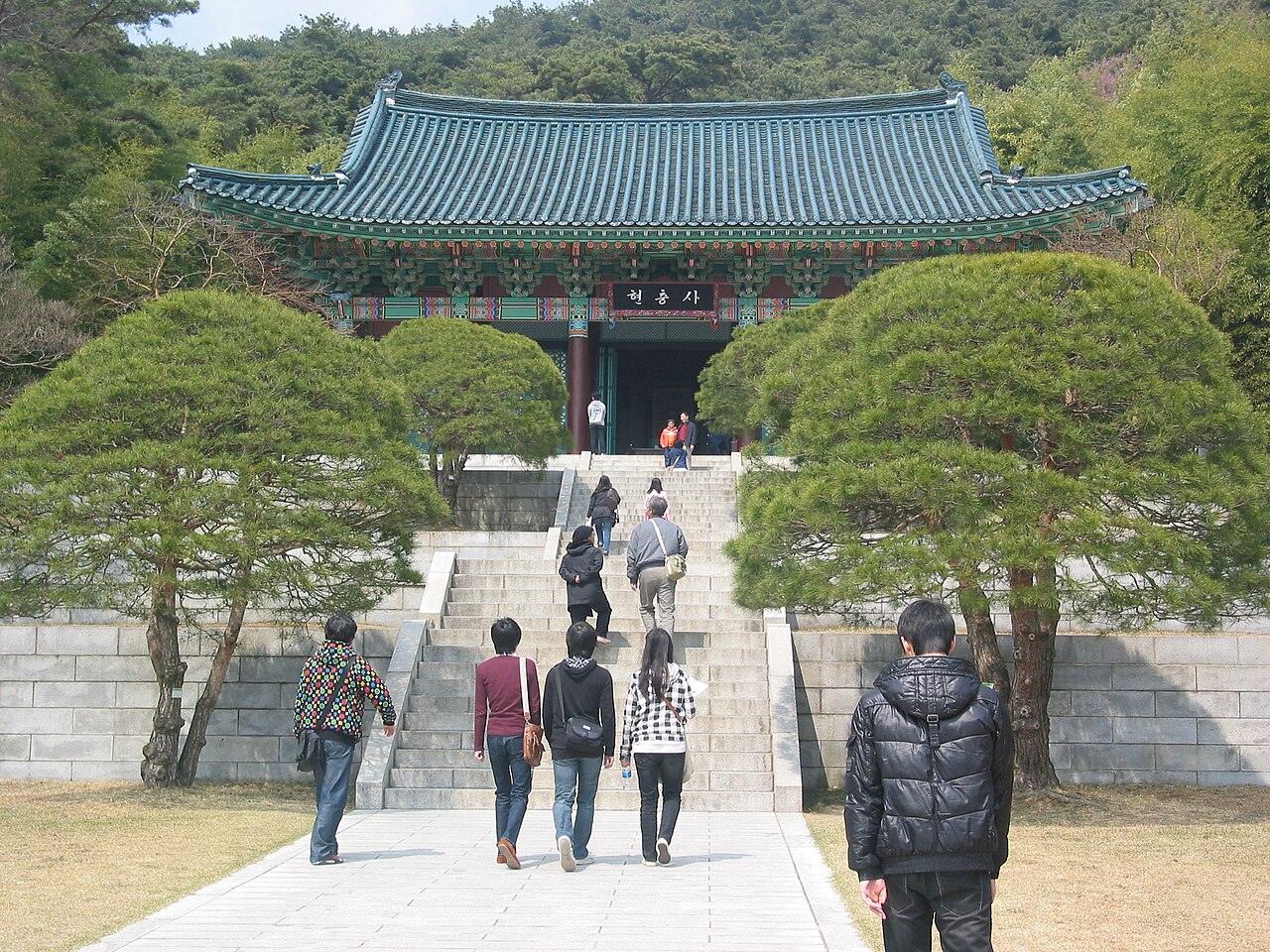
Seven volumes of his autograph drafts, together with a letter album and the Imjin Jangcho, are held at Hyeonchungsa in Asan, South Chungcheong; they were designated National Treasure No. 76 on December 20, 1962, and in June 2013 were inscribed on the UNESCO Memory of the World Register. The Imjin Jangcho (壬辰狀草) is a collection of draft battle dispatches submitted after the naval actions of 1592.
The diary plainly records weather, military affairs and the circumstances of his men, as well as his worry for his mother, feelings for his sons, dreams, drinking, loneliness and distress. The passage on the day he heard of his mother's death in the 4th month of 1597, the passage of October 14 on hearing of the death of his son Myeon, and the long entry for the day of Myeongnyang (September 16) are especially well known. Scholars often note that Won Gyun is criticized in many places.
Slander and Imprisonment (1597)
Before the renewed invasion of 1597, intelligence on the crossing of Kato Kiyomasa, passed through Japanese intermediaries such as Yoshira, reached the court, and Yi was ordered to intercept him at sea. Yi suspected a trap and delayed, and this is said to have become the court's pretext for reprimanding him. Criticism amid his conflict with Won Gyun and disputes over his subordinates' reports are said to have compounded the matter.
On the 25th day of the 2nd lunar month of 1597, Yi was dismissed as commander and arrested, and Won Gyun succeeded him. He was jailed in Hanseong on March 4 and apparently interrogated and tortured, though sources are read differently as to the degree. Jeong Tak and others petitioned to save him, and on April 1 Seonjo released him from prison, sparing his life and sending him to serve in white clothes under Field Marshal Gwon Yul. He had been imprisoned for 28 days.
Popular media often present him as suspected of treason by Seonjo, but the charges that can be confirmed from documents are limited to disobeying the order to sortie and deceiving the court (together with Won Gyun's slanders). Scholarly interpretation of how the case was handled is still debated.
His Mother's Death and Second 'Service in White'
After release Yi set out for Asan. His mother, Lady Byeon, who was traveling from Asan down to Yeosu on hearing of his imprisonment, fell ill and died aboard the boat around April 11 (lunar) of 1597, and Yi heard the news on April 13 and rushed to meet the funeral boat. The War Diary records at length his feelings on receiving her coffin and his lament at being unable to observe the three-year mourning.
After the funeral he could not linger and headed south to Gwon Yul's field headquarters at Chogye (present-day Hapcheon, South Gyeongsang) to begin his service in white. On the road he met displaced villagers and refugees, as well as subordinates and acquaintances, and heard indirect news of the Joseon navy under Won Gyun. The diary also repeatedly mentions this period's meetings with his son Yeol and nephews and concern for his remaining family.
This sorrow is regarded as the darkest stretch of his life, one that led directly into the resolve he showed before the Battle of Myeongnyang.
The Defeat at Chilcheonryang and His Return
On the 16th day of the 7th lunar month of 1597, at the Battle of Chilcheonryang, the Joseon navy under Won Gyun was caught in a Japanese attack and effectively annihilated. Won Gyun, Right Jeolla Naval Commander Yi Eok-gi and Chungcheong Naval Commander Choe Ho are said to have been killed, and Right Gyeongsang Naval Commander Bae Seol (裵楔) is recorded as slipping away with 12 panokseon after burning supplies on Hansando. The naval base Yi had built up around Hansando collapsed in a moment.
On hearing of the defeat the court reappointed Yi as Commander of the Three Naval Provinces in late July (given as the 22nd or 23rd of the 7th lunar month). On August 3 he received the appointment document near Jinju and at once toured the south coast, collecting scattered soldiers, weapons and ships.
When the court, judging the navy too weak, suggested that it join the army, Yi is said to have replied in a dispatch to the effect that he still had twelve warships, that if he fought to the death he could hold, and that as long as he lived the enemy would not dare to despise Joseon. This is the wording of a dispatch included in the Complete Works; the original phrasing varies somewhat between sources.
The Battle of Myeongnyang (September 16, 1597)
Around August 18 Yi took over at Hoeryeongpo the 12 panokseon that Bae Seol had gathered; one more was added, making 13 ships, it is said. He set up camp at Byeokpajin on Jindo on August 29, fought off Japanese scouting vessels on September 7 and other skirmishes, and on September 15 moved to Usuyeong. That day he steeled his officers by saying, in effect, that military doctrine holds that one who is resolved to die will live and one who clings to life will die ('pilsa jeuksaeng, pilsaeng jeuksa'); this appears in the War Diary entry of September 15.
Early on the morning of September 16 (October 26 in the solar calendar), about 133 Japanese ships by the diary's count surged into the Myeongnyang strait (Uldolmok). While Yi's flagship at the head of the Joseon line held the enemy alone, with the ships behind falling back, he is said to have summoned Kim Eung-ham and An Wi to rally them. Other ships, including An Wi's, then joined the fight, and when the tide turned the Japanese fleet is explained to have become tangled in the narrow channel and suffered heavy losses. Records say the Japanese commander Kurushima Michifusa (來島通總) was killed.
The diary and the Seonjo Sillok put damaged Japanese ships at 30 or more, while the Joseon fleet is recorded as losing none; the Myeongnyang Victory Monument in Haenam gives far larger figures, so sources differ greatly. The victory frustrated the Japanese navy's advance into the west sea, and Yi wrote in his diary that it was truly 'heaven's grace' (cheonhaeng).
Amid the triumph, however, Yi suffered a personal tragedy. On October 14 he heard that his youngest son Myeon (葂) had been killed fighting the Japanese at Asan, and wrote at length of his grief in the diary. Myeon is said to have been about 21.
The Gogeumdo Headquarters and the Joseon-Ming Combined Fleet
After Myeongnyang Yi moved north along the west coast and set up camp at Bohwado off Mokpo in late October 1597 (lunar), then in February 1598 moved to Gogeumdo (古今島) and rebuilt the fleet. Near the granary region and with defensible island terrain, Gogeumdo is said to have attracted refugees and become a base for replenishing provisions. A story is also told that he raised provisions by issuing sea-passage permits (haro tonghaengcheop) for a fee.
In the 7th lunar month of 1598 the Ming naval commander Chen Lin (陳璘) arrived at Gogeumdo with some 5,000 men, forming the Joseon-Ming combined fleet. Chen Lin had a reputation for arrogance and a rough temper, but Yi is said to have won his trust by hospitality and by yielding credit for kills. A story circulates that Chen came to revere him and called him 'Laoye,' though the exact wording differs between sources.
On August 18 Toyotomi Hideyoshi died and the Japanese began to withdraw. In September, army and the Joseon-Ming fleet attacked Konishi Yukinaga's forces at Suncheon Waegyo Castle but failed.
The Battle of Noryang and His Death (November 19, 1598)
Learning that a large fleet under Shimazu Yoshihiro and others was approaching the Noryang strait to rescue Konishi Yukinaga at Suncheon Waegyo Castle amid the Japanese withdrawal, Yi sortied on the night of November 18 with Chen Lin's Ming fleet. The Joseon fleet lay in ambush near Gwaneumpo and attacked at dawn on the 19th when the Japanese fleet entered Noryang; after a fierce engagement lasting some eight hours, many Japanese ships were sunk or damaged. The size of the Japanese fleet and its losses vary greatly between sources.
At the end of the battle, as he pursued fleeing Japanese ships toward Gwaneumpo (觀音浦), Yi was struck in the chest by a bullet and fell. He is said to have left the order 'The battle is urgent; do not tell anyone that I have died' (戰方急 愼勿言我死), and it is widely told that his son Hoe (薈) and nephew Yi Wan (李莞) concealed his death and kept the battle going. The episode appears in the Jingbirok and later biographies, though details vary between accounts.
Among those killed in the battle were Joseon officers including Yi Yeong-nam, commander of Garipo, Bang Deok-ryong, magistrate of Nakan, and Go Deuk-jang, magistrate of Heungyang, as well as the Ming deputy commander Deng Zilong (鄧子龍). Chen Lin is said to have wailed on learning of Yi's death, and the people of the south coast mourned him. His last diary entry was written on November 17, two days before his death.
Funeral, Tomb and the Posthumous Title Chungmu
Yi's body was briefly laid at Gogeumdo and then carried via Namhae to his home in Asan, Chungcheong. The funeral burial is said to have taken place on the 11th day of the 2nd lunar month of 1599 at Geumseongsan in Asan; the schedule took time under funeral protocol. In 1614 (the 6th year of Gwanghaegun) the tomb was moved to its present site on Eorasan (於羅山) in Eumbong-myeon, Asan, and the Tomb of Admiral Yi Sun-sin is now Historic Site No. 112.
Posthumous honors accumulated. He was posthumously named Right State Councillor in December 1598; in 1604 (the 37th year of Seonjo) he was enrolled as a first-class Seonmu Meritorious Subject, enfeoffed as Prince Deokpung and raised to Left State Councillor. In 1643 (the 21st year of Injo) the posthumous title Chungmu (忠武) was granted, and in 1793 (the 17th year of Jeongjo) he was further named Chief State Councillor. Jeongjo is said to have personally composed the text of the spirit-way stele in 1794.
The title Chungmu is known as combining chung (loyalty in serving the sovereign at the risk of danger) and mu (martial merit in quelling calamity). In 1795 by Jeongjo's order Yu Deuk-gong and others compiled the Complete Works of Yi Chungmugong in 14 chapters and 8 volumes, collecting his dispatches, diary and biographies.
Family and Descendants
Yi married Lady Bang, daughter of the military official Bang Jin (方震) (given as of the Sangju or Onyang Bang clan), and had three sons, Hoe (薈), Yeol (蔚, whose name is also written 'Ul'), and Myeon (葂), and a daughter. He is also said to have had sons Hun (薰) and Sin (荵) and two daughters by a concubine. The spelling and order of the children's names vary by source.
Hoe stayed at his father's side at Noryang in 1598, and the diary has passages in which Yeol visits his father during his service in white. The youngest, Myeon, was killed fighting the Japanese at Asan in 1597. Yi also raised the nephews orphaned by his elder brothers, and among them Yi Wan (李莞) later made a name as a military officer.
His descendants continued as the Chungmugong branch of the Deoksu Yi clan, with clan activities centered on the Yi Sun-sin old house in the Hyeonchungsa precinct (said to be Bang Jin's former house). The Deoksu Yi clan traces its origin to the founding ancestor Yi Don-su (李敦守), and Yi Sun-sin is the best known of his descendants.
Legacy and Memory - Hyeonchungsa, Jeseungdang, Chungnyeolsa and the Statue
Appraisals of Yi were high from his own time. The historian's comment in the Seonjo Sillok blamed the Chilcheonryang defeat on the court that had put Won Gyun in command, and Ryu Seong-ryong in the Jingbirok lamented his talent and ill fortune. Jeongjo led the compilation of the Complete Works and praised him highly. In modern Korea he has repeatedly ranked first in Gallup polls as the figure Koreans most respect.
Sites commemorating him include Hyeonchungsa in Asan (a shrine permitted in 1706, with the name tablet 'Hyeonchung' conferred in 1707), Chungminsa in Yeosu (founded 1601), Chungnyeolsa in Tongyeong (founded 1606), Jeseungdang on Hansando, and the Myeongnyang Victory Monument at Usuyeong in Haenam (erected 1688). Hyeonchungsa was rebuilt in 1932 by a fundraising campaign under Japanese rule, and expanded on a large scale in the late 1960s. In 1968 a bronze statue of Admiral Yi was erected on Sejong-ro in Seoul (a modern sculpture, not a reproduction of his actual appearance).
Abroad, the British admiral George Alexander Ballard is said to have compared him to Nelson in a 1921 book, and the Japanese naval scholar Sato Tetsutaro and others are known to have rated him highly. The common story that Togo Heihachiro revered him, however, has an uncertain source and cannot be treated as established.
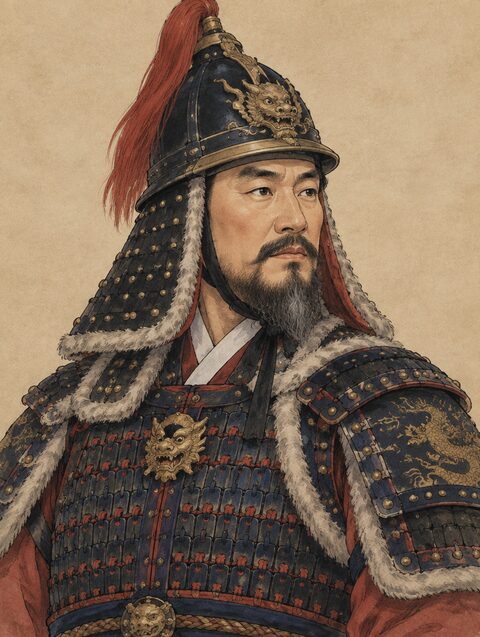
Among portraits, the 1953 painting by Jang U-seong, designated as a government standard portrait in 1973, is held at Hyeonchungsa, but it has been the subject of debate over costume accuracy and controversy about the artist, and its designation has been under review. No portrait made in his own lifetime is known to survive.
Anecdotes and Sayings
Among the sayings attributed to Yi, the best known is 'pilsa jeuksaeng, pilsaeng jeuksa' (必死則生 必生則死: he who resolves to die will live, and he who clings to life will die), which is recorded in the War Diary on September 15, 1597 as a maxim of military science. 'Sin-ege-neun ajik yeoldu-cheok-ui baega isseumnida' (今臣戰船 尙有十二: 'Your servant still has twelve ships') is attributed to a dispatch to Seonjo, but the exact wording varies between sources.
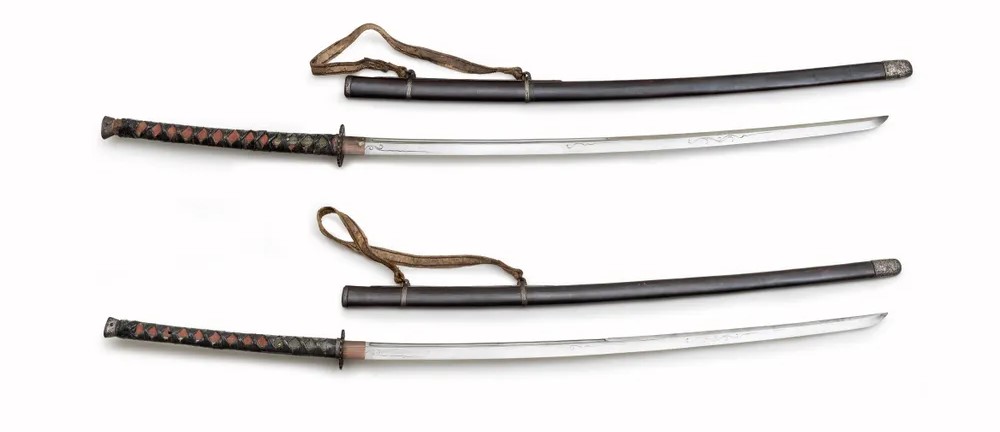
'The battle is urgent; do not announce my death' (戰方急 愼勿言我死) is said to be his last order as he fell at Noryang. It is often shortened to 'do not tell the enemy of my death', but the original aims to prevent panic among his men. An inscription said to have been carved on his swords is also well known: 'A three-foot blade swears to Heaven, and mountains and rivers change color; one sweep clears the foe, and blood dyes the mountains and rivers' (三尺誓天 山河動色 一揮掃蕩 血染山河).
The sijo poem 'Hansando-ga', beginning 'On the night the moon is bright over Hansan Island, I sit alone in the watchtower...' is also attributed to him, but scholars disagree about its authorship and form. Details such as the figure of 12 ships becoming 13 at Myeongnyang, the structure of the turtle ship and the results at Hansando all vary between sources, so widely circulated stories are best read with the sources in hand.
The diary shows him enjoying archery, wine and poetry even in camp, and he is said to have attended to his soldiers' circumstances and kept up ties by shooting with his men. He is also regarded as someone who cared about the lot of slaves, poor soldiers and refugees, a trait often cited as a basis of the respect he receives.
Grave
Mount Eora, Eumbong-myeon, Asan-si, Chungcheongnam-do (Tomb of Admiral Yi Sun-sin, Historic Site No. 112)
Descendants
With Lady Bang he had sons Yi Hoe (李薈), Yi Yeol (李蔚) and Yi Myeon (李葂) and a daughter. His descendants continued as the Chungmugong branch of the Deoksu Yi clan, centered on the Yi Sun-sin old house near Hyeonchungsa in Asan.
Related photos