반남 박씨 family tree
Build your family tree online반남 박씨(潘南 朴氏) — The clan traces its founding ancestor to Park Eung-ju, who served as a Bannam hojang (local administrative chief) during Goryeo, and is known for producing figures such as Park Ji-won (art name Yeonam).
About the 반남 박씨 clan
The clan traces its founding ancestor to Park Eung-ju, who served as a Bannam hojang (local administrative chief) during Goryeo, and is known for producing figures such as Park Ji-won (art name Yeonam). In the 2015 Census the 반남 박씨 clan numbered about 160,964 people, one of Korea's major surnames and clans. Even among people surnamed 박, a different clan seat (bon-gwan, 반남) means a different lineage. New to these terms? See the bon-gwan, pa & hangnyeol guide.
Roots and History of the Bannam Park Clan
Founder and Origin of the Clan Seat
The Bannam Park clan (潘南 朴氏) honors Silla's founding king Park Hyeokgeose (朴赫居世) as its distant progenitor and reveres Park Eung-ju (朴應珠), who served as hojang (local chief) of Bannam County around the reign of Goryeo's King Gojong, as its first-generation founder. Because no records survive for the generations between Park Hyeokgeose and Park Eung-ju, the clan counts its generations from Park Eung-ju, whose family had long lived in Bannam. Based on household records of his fourth-generation descendant Park Su (朴秀) and other sources, the clan believes he was born and raised in Bannam in the early 1200s.
Bannam corresponds to today's Bannam-myeon in Naju, South Jeolla Province. Tradition holds that after Park Eun (朴訔) was enfeoffed as Prince Bannam and later elevated to Prince Geumcheon (錦川府院君) under King Taejong of Joseon, his descendants fixed Bannam, their ancestral home, as the clan seat.
The Clan Through the Ages
The clan rose to prominence with Munjeong-gong Park Sang-chung (朴尙衷), a great-great-grandson of the founder. He passed the civil examination under King Gongmin, served as Pan-jeongyosisa and was known for his mastery of the classics, histories and the Book of Changes. His son, Pyeongdo-gong Park Eun, helped Yi Bang-won during both Princes' Strife after the founding of Joseon, became a Jwamyeong merit subject, and rose through Right State Councillor to Left State Councillor under King Taejong, setting the clan on a firm footing. Anecdotes say he lived so frugally that he ate millet rice even as a minister.
Park Eun's three sons, Park Gyu (朴葵), Park Gang (朴薑) and Park Hwon (朴萱), all reached high office; the descendants of the second son, Park Gang, form the Seyang-gong branch. Park So (朴紹, pen name Yacheon), a great-great-grandson of the eldest son Park Gyu, was a disciple of Jo Gwang-jo, and all five of his sons, Eung-cheon, Eung-sun, Eung-nam, Eung-bok and Eung-in, became prominent. Park Eung-sun's line became the Panseong Buwongun branch, while Park Eung-bok's sons Park Dong-ryang and Park Dong-yeol founded the Ochang-gong and Namgwak-gong branches. Separately, Park Suk, a fourth-generation descendant of Park Sang-chung, settled in Andong, and his sons moved to Yeongju, laying the foundation of the Pangwan-gong branch.
According to local-history sources, during Joseon the clan produced 215 civil-examination graduates, 7 state councillors, 2 Daejehak (chief scholars), 2 queens, 5 Hodang scholars and 1 incorruptible official, making it the most distinguished of all Park clans in terms of office-holding. Queen Inseong (consort of King Injong) and Queen Uiin (consort of King Seonjo) came from this clan, as did Royal Noble Consort Subin Park, mother of King Sunjo. Late Joseon saw scholars such as Park Se-chae, leader of the Soron faction, and Park Se-dang, author of Sabyeonrok, along with Park Ji-won of the Northern Learning school; his grandson Park Gyu-su opened the way for enlightenment thought. In the port-opening era, Park Yeong-hyo and Park Jeong-yang stood at the center of modern politics, while Park Je-sun, condemned as one of the Five Eulsa Traitors, also came from the clan.
Notable Figures
- Park Sang-chung (朴尙衷, 1332-1375) — Late-Goryeo official central to the Munjeong-gong line. He opposed receiving envoys from the Northern Yuan and died on the way to exile.
- Park Eun (朴訔, 1370-1422) — Early-Joseon minister who helped King Taejong, became a Jwamyeong merit subject and rose to Left State Councillor, laying the foundation of the clan's prosperity.
- Park Gang (朴薑, 1406-1460) — Second son of Park Eun, enrolled as a Jwaik merit subject and founder of the Seyang-gong branch.
- Park So (朴紹, 1493-1534) — Pen name Yacheon. A disciple of Jo Gwang-jo whose five sons all prospered and became the roots of several later branches.
- Queen Inseong (仁聖王后, 1514-1577) — Queen consort of King Injong, also remembered for caring for the founder's tomb site.
- Queen Uiin (懿仁王后, 1555-1600) — First queen consort of King Seonjo and daughter of Park Eung-sun, Prince Panseong.
- Park Se-dang (朴世堂, 1629-1703) — Pen name Seogye. A scholar who critically re-examined Zhu Xi's readings of the classics in Sabyeonrok.
- Park Se-chae (朴世采, 1631-1695) — Leader of the Soron faction and ritual scholar who became Left State Councillor and was enshrined in the National Confucian Shrine. View profile
- Park Tae-bo (朴泰輔, 1654-1689) — Son of Park Se-dang who opposed the deposition of Queen Inhyeon during the Gisa Hwanguk and died after brutal interrogation.
- Park Ji-won (朴趾源, 1737-1805) — Pen name Yeonam. Leading prose writer of the Northern Learning school and author of Yeolha Ilgi. View profile
- Royal Noble Consort Subin Park (綏嬪 朴氏, 1770-1822) — Consort of King Jeongjo and mother of King Sunjo.
- Park Gyu-su (朴珪壽, 1807-1877) — Grandson of Park Ji-won who served as Right State Councillor and advocated opening the country and adopting Western learning, influencing the formation of the enlightenment faction.
- Park Jeong-yang (朴定陽, 1841-1904) — Port-opening-era official who served as the first Korean minister plenipotentiary to the United States and later as Prime Minister.
- Park Yeong-hyo (朴泳孝, 1861-1939) — Reformist who led the Gapsin Coup and later collaborated with Japan. View profile
Clan Villages and Heritage Sites
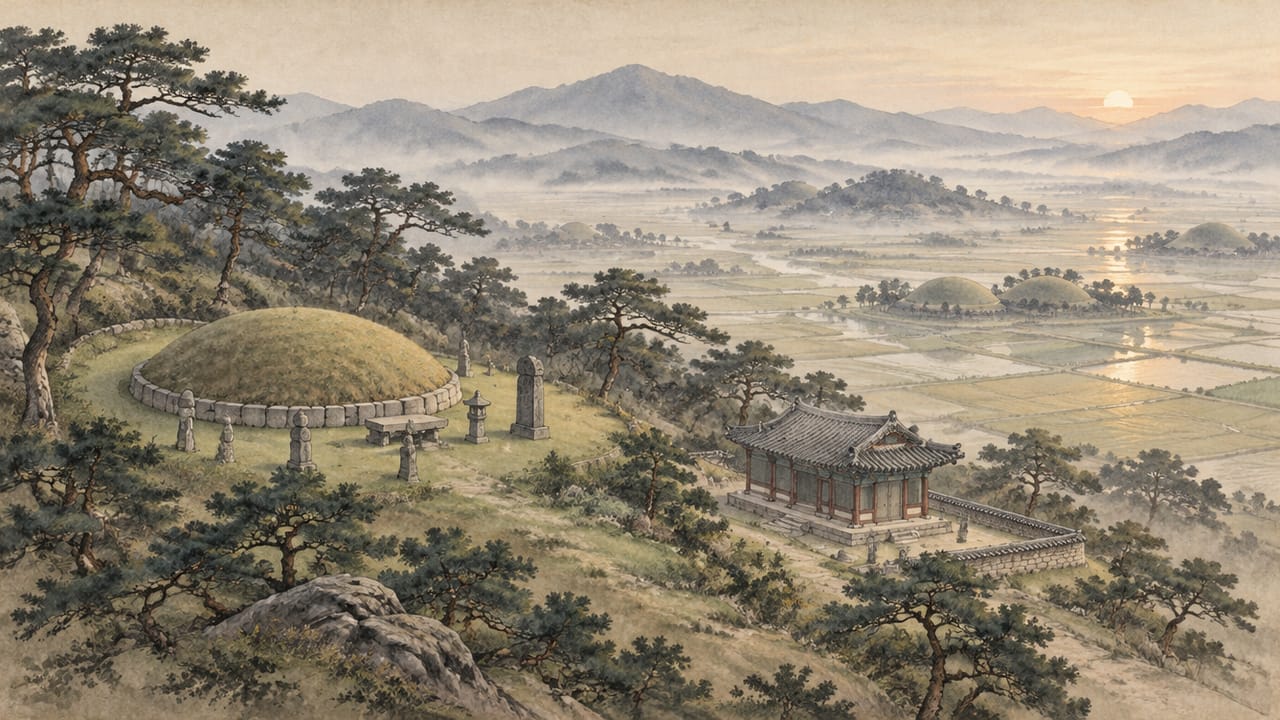
The tomb of founder Park Eung-ju lies at the foot of Jamisan in Heungdeok-ri, Bannam-myeon, Naju. Regarded as the clan's sacred ground, it is nicknamed "Beolmyeongdang." At the entrance stands Sangnojae, a memorial hall built in 1748 (24th year of King Yeongjo). Under King Sejong, Park Eun built Seokcheonam, a small hermitage on the hill to its north, to guard the tomb; it burned in 1739 and was rebuilt at its present location in Seokcheon-ri. Queens Inseong and Uiin issued royal orders to care for the site, and descendants such as Park Dong-yeol under Gwanghaegun and Park Pil-myeong in 1709 re-erected its marker stones.
The clan's villages spread across the country. Besides the old clan village in Bannam, Naju, branch villages are found in Paju and Gimpo (Gyeonggi), Yesan, Tancheon-myeon in Gongju, Sangwol-myeon in Nonsan and Geumsan (South Chungcheong), Chopyeong-myeon in Jincheon (North Chungcheong), Yeongju, Andong, Bonghwa, Mungyeong and Yecheon (North Gyeongsang), Yeongam (South Jeolla), Muju and Jinan (North Jeolla), and Sancheong and Hamyang (South Gyeongsang). Descendants of Park Gyu and Park Gang are said to have settled Jukhyeon village in Yeonggu-ri, Chopyeong-myeon, Jincheon, about 500 years ago, and Museom Village in Yeongju is the best-known home of the Pangwan-gong branch.
Branch divisions and lineages can differ between family organizations and genealogies, so please check against your own family's jokbo.
Main branches (派)
Seyang-gong-pa, Panseong Buwongun-pa, Ochang-gong-pa, Namgwak-gong-pa, Pangwan-gong-pa
Seyang-gong-pa (世襄公派)
The Seyang-gong branch descends from Park Gang (朴薑, 1406-1460), second son of Park Eun (朴訔), Prince Geumcheon and Left State Councillor under King Taejong. He was enrolled as a third-rank Jwaik merit subject for supporting Grand Prince Suyang's accession, and is also known for directing development of the singijeon rocket arrows under King Sejong.
His permanent ancestral shrine and head house stood in Bansong-ri, Hwaseong, and his tomb lies in Hanam. Around 1600 his descendant Park Jeong-geol settled in Mansu-dong, Incheon, which then became home to many members of the branch.
Panseong Buwongun-pa (潘城府院君派)
The Panseong Buwongun branch descends from Park Eung-sun (朴應順), Prince Panseong. He was a son of Yacheon (冶川) Park So (朴紹), a disciple of Jo Gwang-jo, and the father of Queen Uiin, consort of King Seonjo.
All five of Park So's sons, Park Eung-cheon, Park Eung-sun, Park Eung-nam, Park Eung-bok and Park Eung-in, rose to prominence. The branch's clan village is in Tancheon-myeon, Gongju, South Chungcheong.
Ochang-gong-pa (梧窓公派)
The Ochang-gong branch descends from Ochang (梧窓) Park Dong-ryang (朴東亮, 1569-1635), son of Park Eung-bok. For escorting King Seonjo during the Imjin War he was enrolled as a second-rank Hoseong merit subject and made Prince Geumgye, and he served as chief royal secretary, Inspector-General and provincial governor.
His son Park Mi became King Seonjo's son-in-law, and the Soron leader Park Se-chae, the Neo-Confucian scholar Park Pil-ju, the Silhak thinker Park Ji-won and the reformist Park Gyu-su all descend from this branch. His tomb and spirit-path stele are in Gunja-dong, Siheung.
Namgwak-gong-pa (南郭公派)
The Namgwak-gong branch descends from Namgwak (南郭) Park Dong-yeol (朴東說, 1564-1622), Governor of Hwanghae Province. In 1609, while councillor of Rites, he tried in vain to stop King Gwanghaegun from jailing Confucian students over the Jeong In-hong affair, then left the capital as magistrate of Naju and apparently settled in Yeongam.
The branch lives around Naju and Yeongam, South Jeolla; spirit-path steles for Park Dong-yeol, his sons and grandson, and the family shrine hall stand in Eomgil-ri, Seoho-myeon, Yeongam.
Pangwan-gong-pa (判官公派)
The Pangwan-gong branch is known as the Bannam Park branch settled around Yeongju, Andong and Bonghwa in North Gyeongsang. The clan in this area formed when Park Suk (朴塾, 1444-1536), fourth-generation descendant of Munjeong-gong Park Sang-chung, settled at Waryong in Andong and his sons Park Chim and Park Hyeong moved to Yeongju in the early 16th century.
Its clan villages include Museom Village and Munjeong-dong in Yeongju, and Sogo (嘯皐) Park Seung-im, an associate of Toegye Yi Hwang, was Park Hyeong's son.
Branch divisions vary by lineage and jokbo; confirm your own branch in your family's records.
Notable figures
박응주(founder·Goryeo-era hojang of Bannam), 박상충(late-Goryeo official·Munjeong-gong), 박은(early-Joseon Left State Councillor·merit subject), 박강(Jwaik merit subject·founder of Seyang-gong branch), 박소(disciple of Jo Gwang-jo·pen name Yacheon), 인성왕후(queen consort of King Injong), 의인왕후(queen consort of King Seonjo), 박세당(late-Joseon scholar·pen name Seogye), 박세채(Joseon civil official and scholar), 박태보(official who died opposing the Gisa Hwanguk), 박지원(Silhak scholar·pen name Yeonam), 박규수(enlightenment thinker·Right State Councillor), 박정양(first minister to the US·Prime Minister), 박영효(reformist / Gaehwa-pa official)
Tap a name for the full profile (life, career, grave, descendants).
반남 박씨 — Pro-Japanese collaborators
반남 박씨 figures listed by the Presidential Committee or the Dictionary of Pro-Japanese Collaborators (Minjok Munje Institute).
Related Videos
How to build your 반남 박씨 tree
- Start with yourself — sign in to get your own tree. Enter your name, birth year and clan seat (반남).
- Add older generations — add parents and grandparents. For accuracy see tracing ancestors with jejeok records (usually to about 5 generations).
- Link siblings & children — sort by generational name (hangnyeol) to see each generation at a glance.
- Export & share — save the finished tree as a PDF and invite family to manage it together.
Related reading
반남 박씨 clan association
For other branch associations, see the Korean E-Jokbo Library clan-association directory.
✍ Request additions / corrections to the 반남 박씨 family tree infoStart your family tree free →