정철 鄭澈
Mid-Joseon civil official and poet regarded as a master of gasa poetry
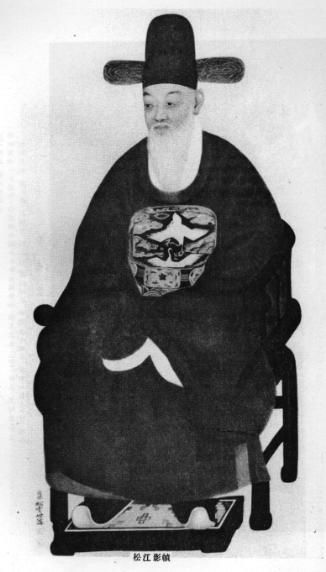
| Life | 1536 ~ 1594 |
| Era | 조선 |
| Clan | 연일 정씨 |
Life & career
Jeong Cheol (鄭澈, 1536-1594) was a mid-Joseon civil official and poet, with the courtesy name Gyeham (季涵) and the art name Songgang (松江); his clan seat was Yeonil (Yeongil). He placed first in the 1562 special civil examination, served as governor of Gangwon, Jeolla and Hamgyeong provinces and as minister of Rites and of Punishments, and rose to Left State Councillor.
A central figure of the Westerners (Seoin) faction, he clashed fiercely with the Easterners after the factional split, and his role as presiding judge in the Gichuk Purge following the Jeong Yeo-rip affair is judged very differently by different sources. In 1591 he was dismissed over the crown-prince (Geonjeo) issue and exiled to Myeongcheon, Jinju and Ganggye, returning to service during the Imjin War.
Writing freely in the vernacular, he brought the gasa form to its peak with Gwandong Byeolgok, Samiingok, Songmiingok and Seongsan Byeolgok, and left several sijo including the Hunmin-ga. His songs are collected in Songgang Gasa and his Chinese poems and prose in Songgang Jip.
Birth and Early Years
Jeong Cheol is said to have been born on the 6th day of the intercalary 12th lunar month of 1536 in Jangui-dong, Hanseong (around today's Cheongun-dong, Seoul), the youngest son of Jeong Yu-chim, an official of the Office of Royal In-laws, and Lady Ahn of Juksan. His eldest sister was a royal concubine of King Injong and his second sister the wife of Prince Gyerim, so he frequented the palace as a child and grew close to Grand Prince Gyeongwon, the future King Myeongjong.
In the Eulsa Purge of 1545 his brother-in-law Prince Gyerim was executed, and the family suffered: his eldest brother died in exile and his father was banished. Around 1551 he moved with his father to Changpyeong in Damyang, where Kim Yun-je took notice of him and taught him; he later studied under Im Eok-ryeong, Song Sun, Kim In-hu and Gi Dae-seung. He befriended Yi I, Seong Hon and Song Ik-pil, and is said to have married a granddaughter of Kim Yun-je.
Examinations and Early Career
He passed the licentiate examination in 1561 and placed first in the 1562 special civil examination, winning the favor of King Myeongjong. He served as inspector, academy official, secretary and county magistrate, and went out as a secret royal inspector to Hamgyeong Province. In 1567 he was selected together with Yi I for the sagadokseo study-leave program, which deepened their friendship.
He is said to have earned the nickname "Chongma Eosa" (the Inspector on the Dappled Horse) for his integrity and upright character.
Factional Split and Years as Governor
When the Eastern–Western split came in 1575 he sided with the Westerners and, attacked by the Easterners, withdrew for a time to Changpyeong. He is said to have written Seongsan Byeolgok around 1578. As governor of Gangwon Province in 1580 he toured the Gwandong region and wrote Gwandong Byeolgok and the Hunmin-ga; he then served as head of the National Academy and governor of Jeolla (1581), as royal secretary and vice-minister of Rites and governor of Hamgyeong (1582), and as minister of Rites and of Punishments (1583).
He mourned Yi I when he died in 1584, and after resigning under Eastern attack in 1585 he lived about four years in Changpyeong, where Samiingok and Songmiingok are said to have been composed.
The Gichuk Purge and Exile
When the Jeong Yeo-rip rebellion broke out in 1589 he served as presiding judge of the trials, and in 1590 he rose to Left State Councillor, was enfeoffed as Prince Inseong and was named a meritorious subject. Many Easterners were executed or exiled in the purge, so the Westerners credit him with suppressing a rebellion while the Easterners and some later historians argue the affair was exaggerated or fabricated by the Westerners; sources therefore judge him very differently.
In 1591, over the succession issue, he and Chief State Councillor Yi San-hae agreed to propose Prince Gwanghae as crown prince, but Yi San-hae broke the agreement and Jeong Cheol alone made the petition, provoking King Seonjo's anger and his dismissal. Impeached by the Easterners, he was exiled to Myeongcheon, then moved via Jinju to Ganggye, where he is said to have been confined within a fenced residence.
The Imjin War and Death
When the Imjin War began in 1592 he was recalled, escorted King Seonjo to Uiju and served as field commissioner, though records criticize him for neglecting duties because of drink. After visiting Ming China as an envoy of thanks in 1593 he resigned, lived at Songjeong village on Ganghwa Island and died there in the 12th lunar month of that year (February 1594 in the solar calendar); his age is given as 58 or 59 depending on the source.
His offices were stripped on impeachment in 1594, restored in 1609 under Gwanghae, and returned in 1624; the posthumous title Munchong (文淸) was granted in 1685, withdrawn in 1691 and restored in 1694 — his reputation rose and fell with the politics of each era. He is enshrined at Songgang Seowon in Changpyeong and elsewhere.
Major Works — Excerpts and Plain-Language Notes
Jeong Cheol's best-known works are gasa (a long verse form) written in Korean — Gwandong Byeolgok, Samiingok, Songmiingok and Seongsan Byeolgok. These four are gasa rather than sijo; his famous sijo are the sixteen Hunmin-ga. Below are short excerpts of each opening, rendered in modern spelling with a plain-language paraphrase; exact orthography differs between editions of Songgang Gasa.
Gwandong Byeolgok (關東別曲)
A travel gasa about touring Mt. Geumgang and the Eight Views of Gwandong after he took up his post as governor of Gangwon in 1580.
Opening (paraphrase) — Sick in the countryside I lay among the bamboo, when the king entrusted me with eight hundred ri of Gwandong; his grace grows boundless. I rushed into the palace, bowed in farewell, and the governor's tally lay before me. Changing horses at Pyeonggu station and turning round Heuksu, I ask where the Seom River is — here is Mt. Chiak; and where does the water of the Soyang River flow? A lonely subject far from the capital, my white hair only grows.
Samiingok (思美人曲)
Written around 1585 while living in retirement at Changpyeong: longing for the king expressed as a woman pining for her beloved through the four seasons.
Opening (paraphrase) — I was born following my lord, a bond of one lifetime that Heaven alone understands. He loved me when I was young and nothing compares to this love. We vowed to live together all our lives — why do you leave me alone in my old age? Only the other day I attended you in the Palace of Gwanghan; how did I come down to the human world? My hair, combed when I left, has been tangled for three years. I have rouge and powder, but for whom should I make myself fair? My sorrows pile up in layers: what I make is sighs, what I shed is tears.
Songmiingok (續思美人曲)
The sequel to Samiingok, a dialogue between two women expressing yearning and loyalty toward the king.
Opening (paraphrase) — (One woman asks:) That woman walking there — I seem to know her. Why did you leave the White Jade Capital in the sky, and whom are you going up to see as the day ends? (The other answers:) Ah, it is you — listen to my story. My looks might deserve his love, yet somehow he regarded me differently. I trusted him with no ulterior thought and tried so hard — why does his welcoming face now differ from before? Lying down and sitting up I reckon it: my own sins are piled like a mountain; whom should I blame, Heaven or men?
Seongsan Byeolgok (星山別曲)
Said to have been composed at Seongsan in Changpyeong for Kim Seong-won, master of Siksyeongjeong and Seohadang, celebrating the four seasons of the mountain and the pleasure of retirement.
Opening (paraphrase) — Winter was over the other day and spring has returned: peach and apricot blossoms bloom in the evening sun, and green willows and fragrant grass are green in the drizzle. Was it cut with a blade or painted with a brush? The marvelous skill of Creation shows in every thing.
* The excerpts are only parts of the works and the paraphrases are loose; please check an edition such as Songgang Gasa for the full text. The date and occasion of Seongsan Byeolgok vary by theory.
Assessment and Anecdotes
Jeong Cheol's gasa shed Sino-Korean stiffness, make free use of the texture of the Korean language and carry a heroic yet plaintive emotion; they are regarded as the summit of gasa literature. In sijo he is counted alongside Yun Seon-do as one of the two great masters, and seventy-seven of his sijo are said to survive in Songgang Gasa.
Upright and outspoken, he was also criticized for drinking, and the Easterners reportedly loathed him enough to give him harsh nicknames; responsibility and fairness in the Gichuk Purge remain debated today.
Anecdotes include the story that Jo Heon at first avoided him but, through Yi I's mediation, worked with him and was reconciled, and that he coined the name "Kkukjeogu" for a fish served in a soup by the people of Gangneung.
Sources: Namuwiki, Wikipedia and other public materials (where sources disagree on dates or details, both are noted above).
Grave
Munbaek-myeon, Jincheon-gun, Chungcheongbuk-do. He was first buried at Sinwon, Goyang, and the tomb was moved in 1665; a spirit-way stele composed by Song Si-yeol stands there, and the tomb was designated a North Chungcheong Provincial Monument in 1996.
Descendants
His eldest son Jeong Gi-myeong is said to have died in 1589, before him. He is revered as the central ancestor of the Munchong-gong (Duke Munchong) line of the Yeonil Jeong clan.