조만식 曺晩植
Educator, independence activist and politician; president of the Korean Products Promotion Society; leader of the Korean Democratic Party (pen name Godang)
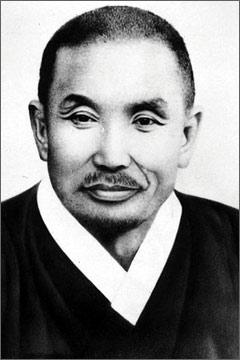
| Life | 1883 ~ 1950 |
| Era | 근현대 |
| Clan | 창녕 조씨 |
Life & career
Jo Man-sik (曺晩植, 1883–1950) was an educator, independence activist and politician of the Changnyeong Cho clan, with the pen name Godang (古堂). Korean Wikipedia says he was born on 1 February 1883 in Gangseo County, South Pyongan Province. He studied at Soongsil Middle School and in the law department of Meiji University in Japan, became a teacher at Osan School in Jeongju, North Pyongan, in 1913 and its principal in 1915.
In 1920 he founded the Korean Products Promotion Society in Pyongyang and led the campaign to buy domestic goods, earning the nickname 'the Gandhi of Joseon'. He served as head of the Pyongyang branch of the Singan Society, and after liberation founded the Korean Democratic Party, but was placed under house arrest in January 1946 for opposing trusteeship. He is known to have died in October 1950, during the Korean War.
Education and Faith
His father, Jo Gyeong-hak, is said to have come from a rural gentry family that worked as a commodity broker in Pyongyang. Jo Man-sik came to Protestant Christianity at a church while sheltering during the Russo-Japanese War in 1904 and entered Soongsil Middle School in Pyongyang in 1905. Around then he gave up tobacco and alcohol and is said to have kept that restraint all his life.
Moved by a speech of Ahn Chang-ho, he came to believe that building national strength was the road to independence and chose to study in Japan, graduating from the law department (specialist course) of Meiji University in March 1913. He is described as having sympathized with Gandhi's non-violence and non-resistance and taken it as a lifelong guide.
Osan School and the March First Movement
He joined Osan School in Jeongju as a teacher in 1913 and became principal in 1915, leading the school for eight years without pay. He took part in the March First Movement in 1919, was arrested and served a year in Pyongyang prison.
The Products Promotion Movement and National Activities
In 1920 he founded the Korean Products Promotion Society in Pyongyang, served as its president and led the campaign to use domestic goods. He was general secretary of the Pyongyang YMCA from 1921 to 1932, took part in forming the Singan Society in 1927 and was chosen head of its Pyongyang branch. In 1932 he became president of the Chosun Ilbo but left after about a year. He was arrested in the 1937 Dongwuhoe Incident and released after some twenty days.
Post-Liberation Politics and House Arrest
After liberation he led the South Pyongan branch of the Committee for the Preparation of Korean Independence and in November 1945 founded the Korean Democratic Party, becoming its leader. He held an anti-communist, anti-trusteeship line and is described as having opposed trusteeship to the end despite Soviet efforts to win him over and pressure on him. In January 1946 he was removed as chairman of the South Pyongan People's Political Committee and placed under house arrest at the Koryo Hotel.
He refused repeated invitations from the South to cross over, saying he could not abandon his compatriots in the North, and in May 1946 sent only his wife Jeon Seon-ae and their children south. He is known to have died in October 1950 during the Korean War; the date is given as both 15 and 18 October, and accounts of how he died differ.
Commemoration and Assessment
He was posthumously awarded the Order of Merit for National Foundation (Republic of Korea medal) in 1970, and the Godang Jo Man-sik Memorial Society was founded in 1976. His hair was interred at the Seoul National Cemetery in 1991 and his wife was buried beside it on her death in 2000.
Suspicions of collaboration were raised over a 1943 article in the Maeil Sinbo urging student conscription under his name; Kim Sam-ung regards it as a fabricated piece, and another view holds that the suspicion was exploited by North Korean political attacks. Together with Jo Bong-am he is counted among the leading modern figures of the Changnyeong Cho clan.