윤이상 尹伊桑
Composer who worked in Germany and a leading figure of contemporary music; imprisoned after the East Berlin affair
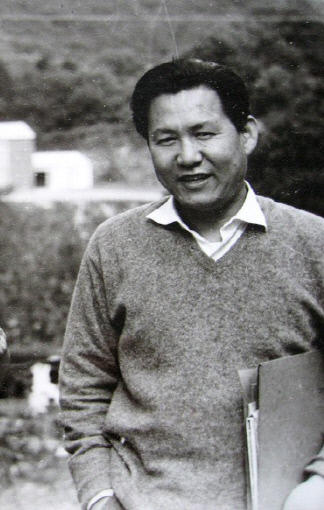
| Life | 1917 ~ 1995 |
| Era | 근현대 |
| Clan | 칠원 윤씨 |
Life & career
Isang Yun (1917-1995) was a Korean-born composer of world standing in contemporary music, whose seat was Chilwon. He was born on 17 September 1917; Korean Wikipedia says in its text that he was born and raised in Tongyeong, South Gyeongsang, while its infobox gives Sancheong, so the birthplace is disputed. He grew up in Tongyeong, learned violin and guitar around thirteen, and in 1935 went to Osaka to study cello, composition and theory. He returned in 1941, worked in music in Tongyeong, married Lee Su-ja in 1950 and moved to Seoul in 1953 to teach.
After the Seoul Culture Prize in 1956 he left for Europe, arriving in Berlin in 1957 and attending the Darmstadt summer courses in 1958. Settling in West Berlin in 1964, he wrote Reak (1966), the operas Butterfly Widow and Sim Cheong (1971-72), the symphonic poem Gwangju Forever! (1981), five symphonies and concertos for cello and violin. He is credited with a unique musical world joining Eastern melodic thought and Western contemporary technique.
In June 1967 the KCIA brought him back to Seoul and tried him for espionage; sentenced to death, he was reduced on retrial and appeal and freed by special pardon in February 1969. This was the East Berlin affair, and in 2006 the National Intelligence Service truth commission said it had been exaggerated and over-interpreted. He took West German citizenship in 1971 and died of pneumonia in Berlin on 3 November 1995. His tomb is an honorary grave in the Landschaftsfriedhof Gatow, Berlin, and a memorial hall stands on his birthplace site at Docheon-dong, Tongyeong.
Music in Europe
After going to Berlin in 1957, Yun entered the European contemporary-music scene by attending the Darmstadt courses in 1958; a photograph survives of him there with Paik Nam-june in 1959. Major works listed by Wikipedia include Music for Seven Instruments (1959), Reak (1966), the operas Butterfly Widow and Sim Cheong, and the cantata My Land, My People (1986-87).
The East Berlin Affair
He had visited North Korea in 1963 and was brought back to Seoul by the KCIA in June 1967. Sentenced to death for espionage, he was reduced and freed in February 1969, and some 200 European musicians submitted petitions. In 2006 the National Intelligence Service truth commission said the case had been exaggerated and over-interpreted. Evaluations have since diverged between South and North, and it is now common to read his musical achievement apart from the political controversy.
Grave
An honorary grave lies in the Landschaftsfriedhof Gatow, Berlin; a memorial hall and a street bearing his name are at his birthplace site in Docheon-dong, Tongyeong.
Descendants
Married Lee Su-ja in 1950.