배극렴 裵克廉
Military official and chief minister of the late Goryeo–early Joseon period; first-class founding merit subject of Joseon (Earl of Seongsan; Jeongjeol-gong)
| Life | 1325 ~ 1392 |
| Era | 고려 말~조선 초 |
| Clan | 성주 배씨 |
Life & career
Bae Geuk-ryeom (裵克廉, 1325-1392) of the Seongju Bae clan was a general and chief minister of the late Goryeo and early Joseon periods. He defended the Gyeongsang region against wokou raiders as a local official and field marshal, and joined the 1388 retreat from Wihwa Island under Yi Seong-gye.
In 1392, acting with Jo Jun and Jeong Do-jeon on the Queen Dowager's edict, he took part in deposing King Gongyang and enthroning Yi Seong-gye. Enrolled as a first-class founding merit subject, he rose to Left Chief Minister and was enfeoffed Earl of Seongsan, but died in December of that year. His posthumous name is Jeongjeol.
Birth and Family
Bae Geuk-ryeom (裵克廉, 1325-1392) of the Seongju Bae clan is said to have been born in 1325 (12th year of King Chungsuk) in Seongju, Gyeongsang Province, as the second son of Bae Hyeon-bo. His courtesy name is given as Yang-ga, his pen names as Jugeumdang and Pilam, and his posthumous name is Jeongjeol (貞節). His great-grandfather is recorded as Bae Yu and his grandfather as Bae Sin-gyeong.
His mother was of the Seongju Yi clan; one reading of the Veritable Records holds that she was a daughter of Yi Cheon-nyeon, which would make him a sixth-degree cousin of the late-Goryeo power-holder Yi In-im. He had an elder brother, Bae Geuk-gwi. Sources differ on some name and clan-seat spellings (Seongju, Gyeongsan, etc.).
Early Career under Goryeo
He entered office through hereditary privilege (muneum) and is said to have served from about 1353 (2nd year of King Gongmin) as magistrate of Jinju and Sangju, mayor of Gyerim (Gyeongju) and Hwaryeong, and garrison commander at Hapo. His career was marked by provincial civil and military posts in the south.
Under King U he served as military commissioner and field marshal of Gyeongsang Province and is recorded as having overseen the construction of the fortress at Hapo (around present-day Changwon).
Campaigns against the Wokou
When wokou raiders struck Gyeongsang Province in 1376 (2nd year of King U), he was named field marshal at Jinju. In 1377 he fought at Yulpo and elsewhere, but is said to have suffered a heavy defeat late that year against a large pirate fleet attacking Gimhae and Uichang. In 1378 he won engagements around Yokji Island and Saju (Sacheon).
In 1379 he defeated raiders who had attacked Jinju at Banseong and gained further successes at Ulju and Saju. The outcome of the 1380 battle at Sageunnae station in Hamyang is reported differently depending on the source (a victory in some accounts, a costly defeat in others). We found no source stating that he took part in Yi Seong-gye's Hwangsan (Unbong) victory of that year, and do not assert it here.
The Wihwado Retreat
In 1388 (14th year of King U), when the order came to attack Liaodong in Ming China, Bae Geuk-ryeom accompanied the army led by Yi Seong-gye as an assistant field marshal of the Right Army. He took part in the retreat from Wihwa Island in the Amnok River and is said to have joined the coup that removed the established power-holders including Choe Yeong.
In 1389 he reportedly served as governor of Gaeseong and Councillor and visited the Ming court as an envoy for the New Year, and in 1390 he was added to the roll of Retreat merit subjects.
Posts in Late Goryeo
In 1390 he oversaw the construction and repair of the palace at Hanyang as inspector of Yanggwang Province and was promoted to Councillor. In 1391 he served as commander of the Central Army in the Three Armies Command and again took charge of the Hanyang palace repairs; a record also credits him with overseeing the inner wall of Gaegyeong.
After being appointed Sumunha Sijung in the fourth month of 1392 he served as Pansasasa and Right Chief Minister, standing among the leading generals and ministers of the Yi Seong-gye camp.
Founding of Joseon and the Enthronement of Yi Seong-gye
In the seventh month of 1392, after the elimination of Jeong Mong-ju had tilted the balance, Bae Geuk-ryeom is said to have led the process of deposing King Gongyang together with Jo Jun and Jeong Do-jeon, acting on the edict of the Queen Dowager (Grand Queen Dowager An). The Veritable Records of Taejo show him petitioning her for the deposition and having the royal seal brought.
The officials then went to Yi Seong-gye's residence to urge him to accept the throne, and he was enthroned at Suchang Palace on 17 July 1392 (lunar 7/17). In the eighth month, in the debate over the heir, he joined Jo Jun and Jeong Do-jeon in recommending Prince Uian (Bangseok); one report says he first argued for succession by the eldest legitimate son. Details of these events vary between sources.
Founding Merit and Offices
In the eighth month of 1392 he was enrolled as a first-class founding merit subject and rose to Left Chief Minister (門下左侍中), effectively the first holder of the top ministerial post of Joseon. Records also list a term as Chief State Councillor from 28 July to 26 November. He was enfeoffed as Earl of Seongsan (星山伯, understood as an old name of Seongju; also written Earl of Seongju) with a fief of 1,000 households.
In the ninth month he is said to have submitted 22 articles to King Taejo on schools, magistrates, relief granaries and local clerks, making him a minister under both Goryeo and Joseon.
Death and Tomb
He is said to have resigned because of illness in the eleventh month of 1392 (lunar) and died two days later. The Veritable Records give his age as 68, while computing from his birth year yields 66-67. King Taejo suspended court for three days and abstained from meat dishes.
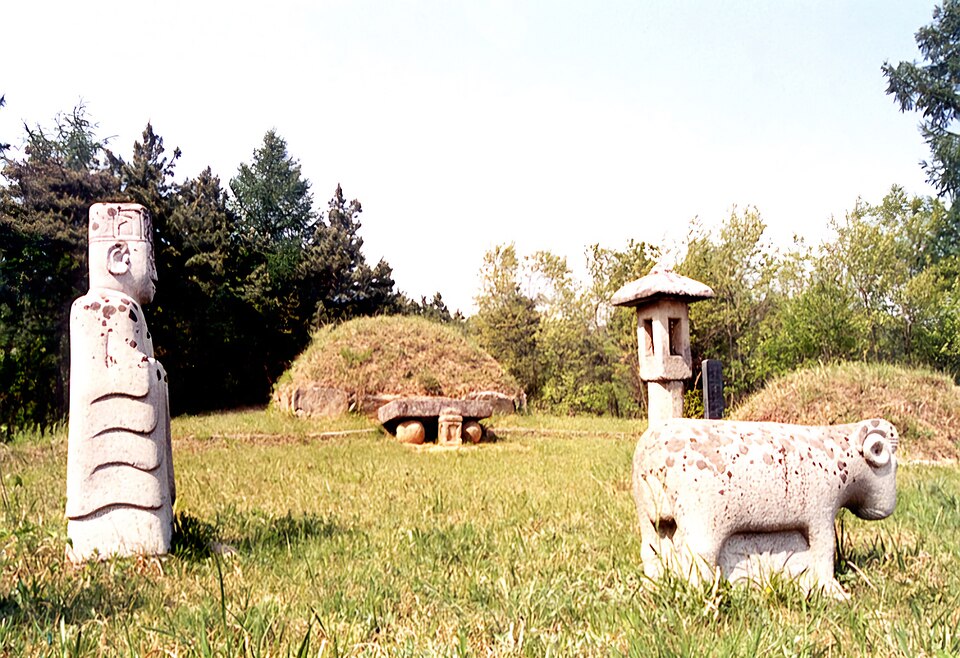
His tomb lies in Songsan-ri, Jeungpyeong-eup, Jeungpyeong County, North Chungcheong Province (at the foot of Mt. Dutasan's Daea Peak) and is designated North Chungcheong Province Monument No. 98. A stone civil official, stone sheep and a stone lantern stand before the mound.
Family and Descendants
His wife was of the Sunheung An clan. Some sources say one daughter married Ban Ja-geon, Prince of Yeongpyeong, while the Veritable Records obituary is reported to say he had no sons, so accounts of his lineage conflict. We could not verify whether he is regarded as a revived ancestor (jungsijo) within the Seongju Bae clan.
Assessment and Records
His obituary in the Veritable Records praises him as honest, frugal and a good provincial governor, skilled in defence though not in offence, but also criticizes him for lack of learning, few suggestions to the king, and deferring to the king's wishes over the crown prince. Jeong Do-jeon's ode Subo-rok portrayed him as having a 'gentleman's wisdom', yet under King Taejong an order is recorded to remove it from the court music because of his short tenure and lack of achievement.
He appears in historical dramas such as KBS's Tears of the Dragon (1996) and Jeong Do-jeon (2014).
Grave
Bae Geuk-ryeom's tomb is located in Songsan-ri, Jeungpyeong-eup, Jeungpyeong County, North Chungcheong Province, and is designated North Chungcheong Province Monument No. 98.
Descendants
His wife was of the Sunheung An clan, and one daughter is said to have married Ban Ja-geon. An account of the Veritable Records obituary says he had no sons, so sources conflict on his lineage.
Related photos