경주 김씨 family tree
Build your family tree online경주 김씨(慶州 金氏) — A surname of the Silla royal-house line, said to descend from Daebogong Kim Al-ji, founder of the Silla Kim clan.
About the 경주 김씨 clan
A surname of the Silla royal-house line, said to descend from Daebogong Kim Al-ji, founder of the Silla Kim clan. In the 2015 Census the 경주 김씨 clan numbered about 1,888,121 people, one of Korea's major surnames and clans. Even among people surnamed 김, a different clan seat (bon-gwan, 경주) means a different lineage. New to these terms? See the bon-gwan, pa & hangnyeol guide.
Roots and history of the Gyeongju Kim clan
Founder and origin of the clan seat
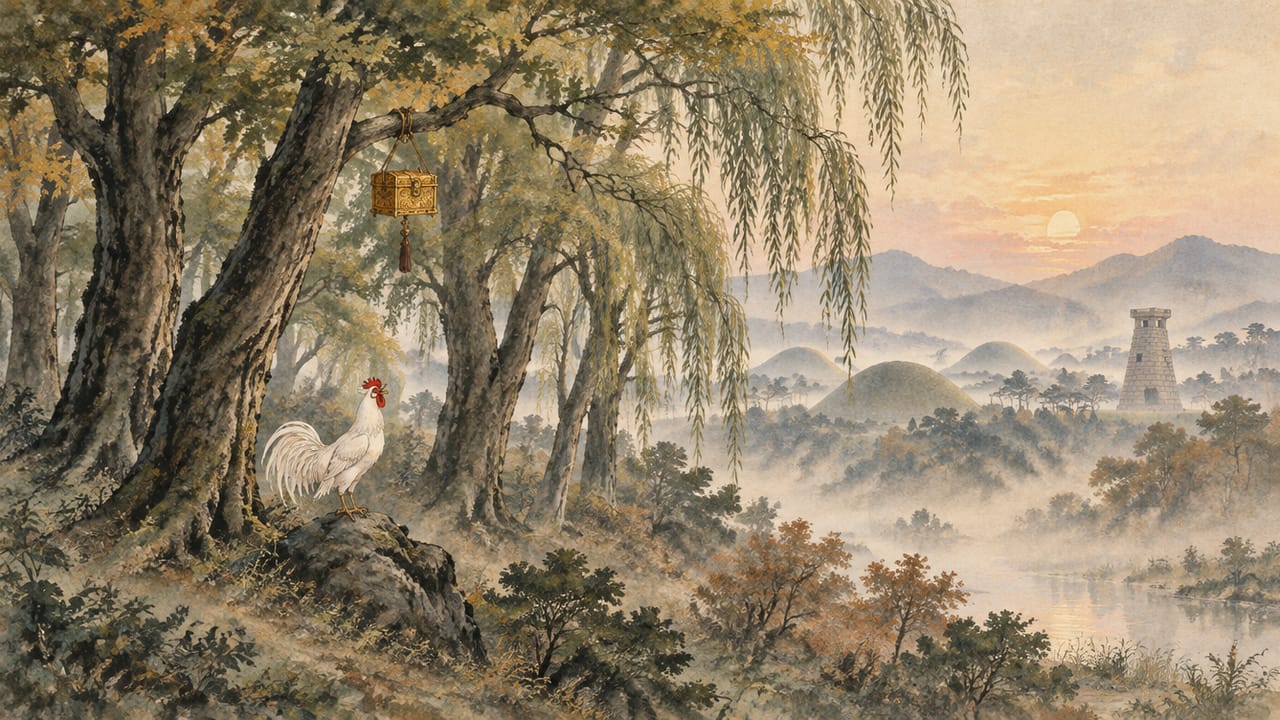
The Gyeongju Kim honor Kim Al-ji (金閼智), founder of the Kim royal house of Silla, as their progenitor. According to the Samguk Sagi, in 65 (the 9th year of King Talhae) a rooster was heard crowing in the Sirim forest west of the capital, Geumseong; there a golden chest hung from a branch, and inside was a baby boy. King Talhae raised the child, naming him Kim ("gold") because he came from a golden chest and Al-ji for his intelligence. The forest was thereafter called Gyerim (鷄林, "rooster forest"), a name later used for Silla itself, which is why the clan is also called the Gyerim Kim or Silla Kim.
Kim Al-ji never reigned, but his seventh-generation descendant Michu (through Sehan, Ado, Suryu, Ukbo and Gudo) became the first Kim king of Silla, its 13th ruler. From Naemul Maripgan onward the Kim held the throne down to Gyeongsun, the 56th king.
When King Gyeongsun surrendered Silla to Wang Geon in 935, the capital Geumseong was renamed Gyeongju (慶州); Gyeongsun received it as his fief and became its sasimgwan (local overseer). His descendants took Gyeongju as their ancestral seat, forming today's Gyeongju Kim clan. In 2015 the clan, counting the Gyeongju and Wolseong Kim together, numbered about 1.89 million, second among Kim clans after the Gimhae Kim.
The clan through history
In Goryeo the clan divided into many lines and entered central government. Representative ones include the Yeongbun-gong branch of Kim Myeong-jong and the Daean-gun branch of Kim Eun-yeol, both said to be sons of King Gyeongsun; the Hojang-gong branch founded by the Gyeongju headman Kim Wi-yeong, which produced Kim Bu-sik and his brothers; the Taesa-gong branch of Kim In-gwan from King Yejong's time; the Janggun-gong branch of the early Goryeo general Kim Sun-ung; and the Pandopanseo-gong branch of the late Goryeo minister Kim Jang-yu. Dozens more are recorded, including the Naesaryeong-gong, Pyeongjangsa-gong, Sangseo-gong, Moksa-gong and Jikjang-gong branches. At the end of Goryeo, Kim Ja-su of the Taesa-gong line refused to serve Joseon and took his own life, becoming a symbol of loyalty; his descendants form the Sangchon-gong branch.
Under Joseon the clan produced notable figures among both the Neo-Confucian literati and the royal in-laws. Kim Jeong (Chungam) pursued reform with Jo Gwang-jo and died in exile on Jeju after the Gimyo purge; Kim Hong-uk (Hakju) was beaten to death on King Hyojong's orders for petitioning to clear the name of Crown Princess Kang. Kim Ju-sin's daughter became Queen Inwon, second queen of King Sukjong; under King Yeongjo, the daughter of Kim Han-gu, a descendant of Kim Hong-uk, became Queen Jeongsun, Yeongjo's second queen, and Kim Han-sin of the same family married Yeongjo's daughter Princess Hwasun and was made Lord Wolseong. Kim Han-sin's great-grandson was Chusa Kim Jeong-hui.
In the opening-port era the clan produced Kim Hong-jip, prime minister who led the Gabo Reform, and under Japanese rule Kim Gyo-heon, second leader of Daejonggyo and a pioneer of nationalist historiography.
Notable figures
- Kim Al-ji (金閼智) — Progenitor of the Gyeongju Kim and the Kim royal house of Silla, said to have been found in a golden chest in Gyerim.
- Michu Isageum (味鄒尼師今) — Seventh-generation descendant of Kim Al-ji and the first Kim king of Silla (13th ruler).
- King Gyeongsun (敬順王) — 56th and last king of Silla, who submitted to Goryeo in 935; many Gyeongju Kim branches regard him as their ancestor.
- Kim Bu-sik (金富軾, 1075-1151) — Mid-Goryeo statesman and scholar who led the compilation of the Samguk Sagi; of the Hojang-gong line.
- Kim In-gwan (金仁琯) — Acting Grand Tutor to the Crown Prince around King Yejong's reign and founder of the Taesa-gong branch.
- Kim Ja-su (金自粹, 1351-1413) — Pen name Sangchon. Late-Goryeo Minister of Punishments who refused King Taejong's summons out of loyalty to Goryeo; founder of the Sangchon-gong branch.
- Kim Jeong (金淨, 1486-1521) — Pen name Chungam. A reformer alongside Jo Gwang-jo, he was exiled to Jeju after the Gimyo purge and ordered to die there; in exile he wrote Jeju pungtorok, an account of the island.
- Kim Hong-uk (金弘郁, 1602-1654) — Pen name Hakju. Beaten to death for petitioning to clear Crown Princess Kang's name and later exonerated; honored as the mid-founder of the Hakju-gong branch.
- Kim Ju-sin (金柱臣, 1661-1721) — Father of Queen Inwon, second queen of King Sukjong, and made Prince Gyeongeun.
- Kim Han-sin (金漢藎, 1720-1758) — Lord Wolseong, husband of King Yeongjo's second daughter Princess Hwasun and great-grandfather of Kim Jeong-hui.
- Queen Jeongsun (貞純王后, 1745-1805) — Daughter of Kim Han-gu, second queen of King Yeongjo, who acted as regent early in King Sunjo's reign.
- Kim Jeong-hui (金正喜, 1786-1856) — Calligrapher and epigraphist who perfected the Chusa style and identified the Bukhansan monument of King Jinheung.
- Kim Hong-jip (金弘集, 1842-1896) — Prime minister who led the Gabo Reform; he was killed by an angry crowd just after King Gojong fled to the Russian legation.
- Kim Gyo-heon (金敎獻, 1868-1923) — Second leader of Daejonggyo, devoted to the independence movement and nationalist historical research in Manchuria.
Clan lands and heritage sites
The Gyeongju Kim live throughout Korea, including their seat of Gyeongju, North Gyeongsang, Gyeonggi, Chungcheong, North Jeolla and Gangwon, with each branch forming its own clan villages.
- Gyerim Forest, Gyeongju — The grove between Cheomseongdae and Wolseong where Kim Al-ji is said to have been born. It is a designated Historic Site, and inside stands a late-Joseon stele and pavilion recording his birth.
- Sunghyejeon Shrine — A shrine beside the tomb of King Michu in Gyeongju, holding the spirit tablets of Michu, the first Kim king; Munmu, who unified the Three Kingdoms; and Gyeongsun, the last king. After the Imjin War destroyed the original, a shrine to Gyeongsun was built in Dongcheon-dong in 1627 and moved to the present site in 1794; Michu's tablet was added in 1887 and Munmu's the following year, when it was named Sunghyejeon. The Silla Kim clans hold rites there every year.
- Tomb of King Gyeongsun, Yeoncheon — In Gorangpo-ri, Jangnam-myeon, Yeoncheon County, Gyeonggi, it is the only Silla royal tomb outside Gyeongju. When Gyeongsun died in 978 the Goryeo court is said to have refused to let him be buried in Gyeongju, so he was laid to rest here near Gaegyeong; descendants rediscovered his epitaph stone and restored the tomb in 1747. It is a designated Historic Site.
- Chusa Historic House, Yesan — Kim Jeong-hui's birthplace in Sinam-myeon, Yesan, South Chungcheong, said to have been built by his great-grandfather Kim Han-sin. Nearby are the joint tomb of Kim Han-sin and Princess Hwasun and the gate honoring the princess.
- Other sites — Kim Ja-su's tomb, a Gyeonggi-do monument, and the Chuwonjae hall in Andong are described in the Sangchon-gong card above; the tombs of Kim Hong-uk and his father are in Seosan, South Chungcheong.
Branch divisions and genealogies vary by lineage and jokbo; confirm your own line in your family's records.
Main branches (派)
Yeongbun-gong branch, Daean-gun branch, Taesa-gong branch, Sangchon-gong branch, Pandopanseo-gong branch, Janggun-gong branch, Hojang-gong branch
Yeongbun-gong branch (永芬公派)
The Yeongbun-gong branch descends from Kim Myeong-jong (金鳴鍾), said to have been the third son of Gyeongsun (敬順王), the last king of Silla. The branch takes its name from his Goryeo title, Duke Yeongbun (永芬公).
As a branch founded by a son of King Gyeongsun it is one of the clan's major lines, and later sub-branches such as the Sueun-gong branch (樹隱公派) are said to descend from it.
Daean-gun branch (大安君派)
The Daean-gun branch descends from Kim Eun-yeol (金殷說), said to have been a son of King Gyeongsun (some records call him the fourth son). It is named after his title, Lord Daean (大安君).
Linked by marriage to the early Goryeo royal house, it formed one of the clan's major lines.
Taesa-gong branch (太師公派)
The Taesa-gong branch descends from Kim In-gwan (金仁琯), who served around the reign of King Yejong of Goryeo as Acting Grand Tutor to the Crown Prince (檢校太子太師). He is said to descend from the Silla royal house (some records say from King Heongang), but his exact link to King Gyeongsun is not fully documented.
It is counted as the most flourishing of the Gyeongju Kim branches, and large sub-branches such as the Sangchon-gong branch grew out of it. Kim Se-pil of mid-Joseon, Kim Hong-uk (Hakju), Queen Jeongsun (second queen of King Yeongjo) and Kim Jeong-hui (Chusa) are counted among its members.
Sangchon-gong branch (桑村公派)
The Sangchon-gong branch of the Gyeongju Kim (慶州金氏 桑村公派) is a major branch whose founder is Kim Ja-su (金自粹, 1351-1413), the ninth-generation descendant of Taesa-gong Kim In-gwan, who is said to descend from Gyeongsun, the 56th king of Silla. It grew out of the Taesa-gong branch and is named after Kim Ja-su's pen name, Sangchon (桑村).
Kim Ja-su (courtesy name Sunjung, 純仲) studied under Yi Saek and Jeong Mong-ju, passed the civil service examination in 1374 (23rd year of King Gongmin), and rose in late Goryeo to Minister of Punishments (形曹判書). After Joseon was founded, King Taejong summoned him again to that post; on his way to the capital he took his own life at Churyeong in Gwangju (today's Bundang, Seongnam), and he is honored for his loyalty to Goryeo. He is said to have asked that no tombstone be raised on his grave, and his collected works, Sangchonjip (桑村集), survive. His tomb is a Gyeonggi-do monument, and the Chuwonjae shrine hall and a filial-piety stele remain in Andong.
Kim Hong-uk (金弘郁, Hakju), the late-Joseon governor of Chungcheong who championed the Daedong tax law, wrote the calligraphy for Kim Ja-su's spirit-path stele in 1654. Queen Jeongsun (second queen of King Yeongjo), the royal son-in-law Kim Han-sin, and Kim Jeong-hui (Chusa) are said to have come from Kim Hong-uk's descendants.
Pandopanseo-gong branch (版圖判書公派)
The Pandopanseo-gong branch descends from Kim Jang-yu (金將有), who served in late Goryeo as Minister (判書) of the Pando Bureau (版圖司), which oversaw census, land and taxation. He is said to descend from King Gyeongsun.
Kim Jeong (金淨), his sixth-generation descendant who died in the Gimyo literati purge of 1519, is counted among its members.
Janggun-gong branch (將軍公派)
The Janggun-gong branch descends from Kim Sun-ung (金順雄), said to have been a general (大將軍) around the reign of King Mokjong in early Goryeo. Some also hold that he descends from King Wonseong (元聖王) of Silla.
Later sub-branches such as the Gyerim-gun branch (鷄林君派), founded by Kim Gyun, Lord Gyerim and a founding merit subject of Joseon, grew out of it. Kim Ju-sin, father of Queen Inwon (second queen of King Sukjong), and Kim Hong-jip, prime minister in the late Joseon/Korean Empire period, are counted among its members.
Hojang-gong branch (戶長公派)
The Hojang-gong branch descends from Kim Wi-yeong (金魏英), who served in early Goryeo as Hojang (戶長), head of the local functionaries of Gyeongju.
The great scholar Kim Bu-sik (金富軾), compiler of the Samguk Sagi, and his brothers Kim Bu-il and Kim Bu-ui came from this line.
Branch divisions vary by lineage and jokbo; confirm your own branch in your family's records.
Notable figures
김알지(founder of the Gyeongju Kim clan), 경순왕(last king of Silla), 김명종(founder of the Yeongbun-gong branch), 김은열(founder of the Daean-gun branch), 김인관(founder of the Taesa-gong branch), 김자수(founder of the Sangchon-gong branch), 김장유(founder of the Pandopanseo-gong branch), 김순웅(founder of the Janggun-gong branch), 김위영(founder of the Hojang-gong branch), 김부식(compiled the Samguk Sagi), 김정(Chungam; scholar of the Gimyo purge), 김정희(Chusa; calligrapher), 김홍집(prime minister of Joseon), 김교헌(second leader of Daejonggyo)
Tap a name for the full profile (life, career, grave, descendants).
경주 김씨 — Independence patriots
경주 김씨 figures recognized as independence patriots (National Independence Hall / Gonghun public data). Tap a name for the citation.
▼ Show more (26 more)▲ Collapse
경주 김씨 — Pro-Japanese collaborators
경주 김씨 figures listed by the Presidential Committee or the Dictionary of Pro-Japanese Collaborators (Minjok Munje Institute).
▼ Show more (5 more)▲ Collapse
The Gyeongju Kim clan and the Silla royal house
The Gyeongju Kim are descended from the royal house of Silla; the clan's progenitor is Kim Al-ji (金閼智). After Gyeongsun (敬順王), Silla's last king, submitted to Goryeo in 935, his descendants split into several great branches. Today the clan numbers about 1.8 million — the second-largest Kim clan after the Gimhae Kim. Each great branch and its founder is described under Main branches above.
Branch genealogies and origins vary by lineage and jokbo, and some lines' connection to King Gyeongsun is not fully documented. Confirm your own line in your family's records.
Related Videos
How to build your 경주 김씨 tree
- Start with yourself — sign in to get your own tree. Enter your name, birth year and clan seat (경주).
- Add older generations — add parents and grandparents. For accuracy see tracing ancestors with jejeok records (usually to about 5 generations).
- Link siblings & children — sort by generational name (hangnyeol) to see each generation at a glance.
- Export & share — save the finished tree as a PDF and invite family to manage it together.
Related reading
경주 김씨 clan association
For other branch associations, see the Korean E-Jokbo Library clan-association directory.
✍ Request additions / corrections to the 경주 김씨 family tree infoStart your family tree free →